






For decades, academic systems have followed a familiar structure: fixed classrooms, standardized curricula, scheduled learning hours, and uniform assessments. This model once worked effectively for a world that valued consistency and predictability.
But the world has changed.
Today’s learners are growing up in a digital-first environment where information is instant, expectations are dynamic, and adaptability is essential. Yet, many academic systems still operate on outdated frameworks that struggle to meet modern demands.
The result is a growing gap between how education is delivered and how learning actually happens.
The Problem with One-Size-Fits-All Learning
Traditional academic systems are built on standardization. Every student is expected to follow the same pace, the same content, and the same evaluation methods.
While this simplifies administration, it overlooks a critical reality:
no two learners are the same.
Students differ in:
- Learning speed
- Preferred learning styles
- Strengths and weaknesses
- Interests and career goals
Yet, traditional systems rarely account for these differences.
This often leads to:
- Disengaged students
- Uneven learning outcomes
- Over-reliance on memorization
- Limited critical thinking development
AI is beginning to challenge this model by introducing adaptive learning experiences that respond to individual progress. Platforms such as Synclo are increasingly incorporating intelligent learning flows that adjust based on how learners interact with content, making education more responsive and personalized.
Limited Access to Real-World Learning
Another key limitation of traditional academic systems is their disconnect from real-world applications.
Classroom learning often focuses on theory, while practical skills and industry relevance take a back seat. Students may graduate with strong academic knowledge but lack the applied skills required in professional environments.
This gap creates challenges for both learners and employers.
AI-powered learning platforms are helping bridge this divide by:
- Recommending skill-based learning paths
- Integrating real-world scenarios into training
- Providing continuous feedback based on performance
Systems like Synclo enable organizations and institutions to design learning programs that align more closely with real-world outcomes, ensuring that knowledge translates into capability.
The Constraints of Time and Location
Traditional education is bound by time and place. Learning happens in classrooms, within specific hours, and often follows rigid schedules.
This structure creates limitations:
- Students must adapt their lives around learning
- Opportunities for revision and flexibility are restricted
- Learning becomes episodic rather than continuous
In contrast, modern learners expect access anytime, anywhere.
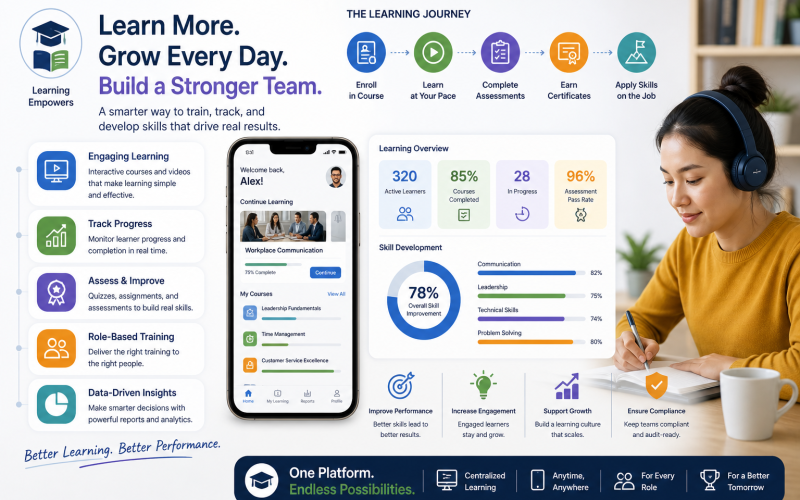
AI-driven LMS platforms support this shift by enabling:
- On-demand learning
- Mobile-first access
- Continuous progress tracking
Platforms such as Synclo make it possible to move beyond classroom boundaries, allowing learners to engage with content whenever it suits them, without losing structure or accountability.
Delayed Feedback and Inefficient Assessments
In traditional systems, assessments are often slow and reactive.
Students complete assignments, wait for grading, and receive feedback days or weeks later. By the time feedback arrives, the learning moment may have already passed.
This delay reduces the effectiveness of the learning process.
AI changes this dynamic by enabling:
- Instant feedback
- Automated grading for objective assessments
- Real-time performance tracking
This allows learners to adjust immediately and stay engaged with the material.
In structured systems like Synclo, assessments and feedback are integrated into the learning workflow, making evaluation faster, more consistent, and easier to manage at scale.
Administrative Complexity in Academic Institutions
Behind the scenes, academic institutions face significant operational challenges.
Managing:
- Student records
- Course structures
- Attendance
- Assessments
- Faculty coordination
often involves multiple disconnected systems.
This creates inefficiencies such as:
- Duplicate data entry
- Errors in recordkeeping
- Delayed reporting
- Lack of centralized visibility
Modern platforms address this by consolidating these functions into a single system. Synclo, for example, provides a unified environment where academic administration and learning processes can coexist, reducing complexity and improving operational efficiency.
The Rise of Data-Driven Education
Education systems generate vast amounts of data, but traditional models rarely use it effectively.
AI enables institutions to turn this data into actionable insights.
With intelligent analytics, institutions can:
- Identify struggling students early
- Track engagement patterns
- Improve course design
- Measure learning effectiveness
This shift toward data-driven education allows institutions to move from reactive decision-making to proactive improvement.
Platforms like Synclo support this transition by providing centralized data and analytics, helping institutions make informed decisions that enhance learning outcomes.
The Changing Role of Educators
In traditional systems, educators are often positioned as the primary source of knowledge.
However, in an AI-driven environment, their role evolves.
Educators become:
- Facilitators of learning
- Mentors and guides
- Designers of learning experiences
AI handles repetitive and administrative tasks, allowing educators to focus on meaningful interactions with students.
Systems such as Synclo support this shift by reducing administrative overhead and providing tools that enhance teaching effectiveness without replacing human involvement.
What Comes Next: A Smarter Learning Ecosystem
The future of education is not about eliminating traditional systems entirely, but transforming them.
The next generation of academic systems will be:
1. Adaptive
Learning paths will adjust dynamically based on individual progress.
2. Continuous
Education will extend beyond classrooms into lifelong learning journeys.
3. Connected
All aspects of learning, from content to assessment, will exist within unified systems.
4. Data-Driven
Decisions will be based on real-time insights rather than assumptions.
5. Scalable
Systems will support growth without increasing complexity.
AI will play a central role in enabling this transformation.
Conclusion
Traditional academic systems are not failing because they are ineffective — they are failing because they are no longer aligned with how the world learns and works today. Rigid structures, delayed feedback, limited accessibility, and fragmented systems are holding education back from reaching its full potential. AI offers a path forward. By enabling personalization, real-time insights, and continuous learning, AI is reshaping education into something more flexible, more relevant, and more impactful. Platforms like Synclo represent this shift — not by replacing education, but by supporting a more connected, intelligent, and scalable approach to learning. The future of education lies beyond the classroom. And it is already taking shape.
