







- Financial complexity is increasing as businesses adopt more tools and fragmented systems
- Real-time financial visibility is becoming critical for faster, smarter decision-making
- Unified platforms like Synclo are redefining how businesses manage finance and operations
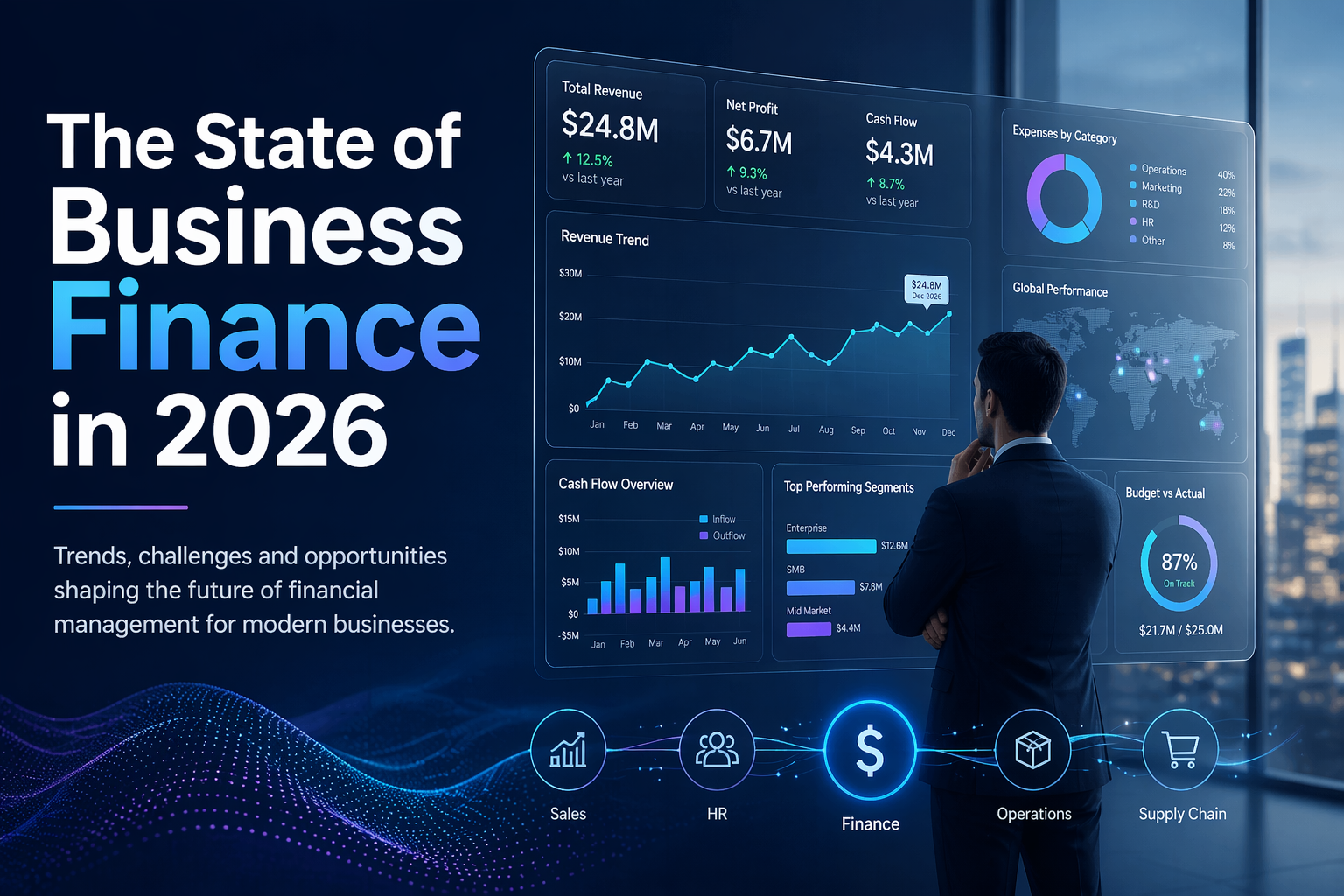
Business finance is no longer just about managing numbers. It has become a dynamic, real-time system that reflects everything happening across an organization.
In 2026, the way companies handle finance is changing rapidly. Growth is no longer limited by demand or opportunity. It is limited by how well a business can manage complexity.
And that complexity is increasing.
Across industries, companies are dealing with more tools, more data, and more moving parts than ever before. While technology has enabled growth, it has also introduced new challenges—especially in finance.
What used to be a structured, predictable function has now become one of the most complex areas of business operations.
Finance Is Expanding Beyond the Finance Team
The traditional role of finance has shifted. It is no longer confined to accounting teams or end-of-month reporting.
Today, finance is embedded in every function:
- Sales decisions impact revenue forecasting
- Hiring decisions affect cost structures
- Operations influence margins and efficiency
- Supply chain performance impacts cash flow
This means financial outcomes are no longer controlled by one department. They are shaped by the entire organization.
However, most businesses are still using systems that treat finance as a separate function.
This disconnect is creating a growing gap between what is happening in the business and what finance is able to track in real time.
More Tools, Less Clarity
Over the past decade, businesses have adopted a wide range of software tools to improve productivity.
A CRM for sales.
A payroll system for HR.
An accounting platform for finance.
Separate tools for projects, support, and operations.
Individually, these tools work well.
But together, they create fragmentation.
Data lives in different systems.
Teams operate with different information.
Reports take time to compile and verify.
Instead of simplifying operations, technology has made them more complex.
This is why many businesses are now rethinking the idea of using multiple tools and moving toward all-in-one ERP software and business software suites that unify operations.
The Rise of Real-Time Financial Expectations
Speed has become a defining factor in modern business.
Decisions can no longer wait for weekly reports or monthly summaries. Leaders need to understand what is happening in real time.
Without real-time visibility:
- cash flow issues are identified too late
- operational inefficiencies go unnoticed
- opportunities are missed
A cloud-based ERP system changes this dynamic by providing continuous access to financial and operational data.
Platforms like Synclo enable businesses to move from delayed reporting to real-time financial awareness.
This shift is not just about convenience. It is about staying competitive.
From Historical Reporting to Forward-Looking Decisions
Finance has traditionally been backward-looking.
Reports are generated after transactions are completed. Insights are derived from past performance.
But in 2026, this approach is no longer enough.
Businesses are moving toward systems that support forward-looking decisions:
- predicting cash flow trends
- identifying potential risks
- optimizing resource allocation
This is where AI-powered business management is making an impact.
Instead of simply recording data, modern systems analyze it, identify patterns, and provide recommendations.
This allows finance teams to play a more strategic role in business growth.
Integration Is Becoming the New Standard
As complexity increases, integration is no longer optional.
Businesses need systems that connect:
- finance with HR
- finance with sales
- finance with operations
This is driving demand for solutions like:
- ERP with HR, CRM and accounting
- integrated ERP systems
- centralized business operations software
The goal is simple: create a single environment where all data flows together.
Synclo is built around this model, enabling organizations to operate within a unified system rather than across disconnected tools.
Small Businesses Facing Enterprise-Level Complexity
One of the most important shifts in 2026 is the rise of complexity in small and mid-sized businesses.
What used to be enterprise-level challenges are now affecting smaller companies:
- multi-channel sales
- distributed teams
- complex financial workflows
This has increased demand for:
- ERP software for small business
- affordable ERP software
- scalable business systems
Businesses are no longer choosing systems based only on current needs. They are choosing systems that can support future growth.
The Shift Toward Unified Business Systems
The idea of managing different functions separately is gradually being replaced by unified systems.
Companies are moving toward:
- all-in-one business management software
- ERP CRM HRMS combined software
- end-to-end business automation
These systems are designed to eliminate silos and create a consistent flow of information across the organization.
The benefit is not just efficiency. It is clarity.
When all parts of the business are connected, decision-making becomes faster and more accurate.
What This Means for the Future
The future of business finance is not about adding more tools. It is about reducing complexity.
Companies that succeed will be the ones that:
- simplify their systems
- integrate their operations
- prioritize real-time visibility
Finance will continue to evolve from a reporting function into a control system that guides the entire business.
Final Thoughts
Business finance in 2026 is no longer a standalone function. It is a reflection of how well a business operates as a whole.
As systems become more connected and data becomes more accessible, the role of finance will continue to expand.
The challenge for businesses is not adopting more technology. It is adopting the right kind of technology.
Unified platforms like Synclo represent this shift—bringing together finance, operations, and decision-making into a single system.
Because in the end, better finance doesn’t come from better accounting.
It comes from better visibility, better integration, and better control across the entire business.
