





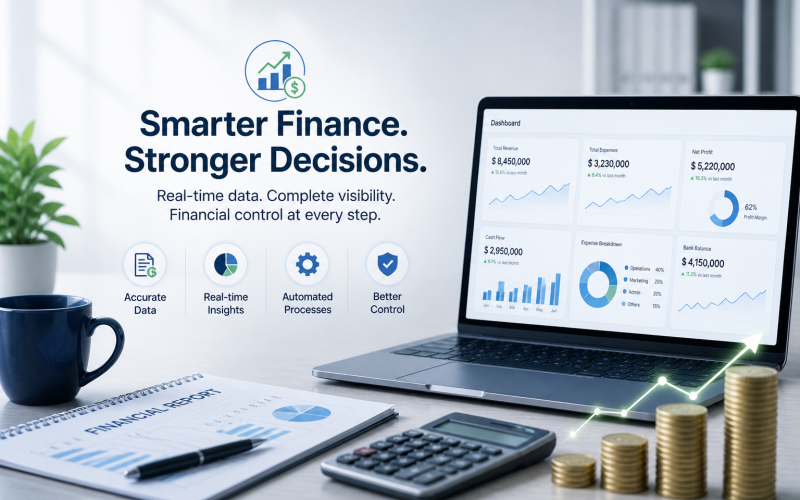
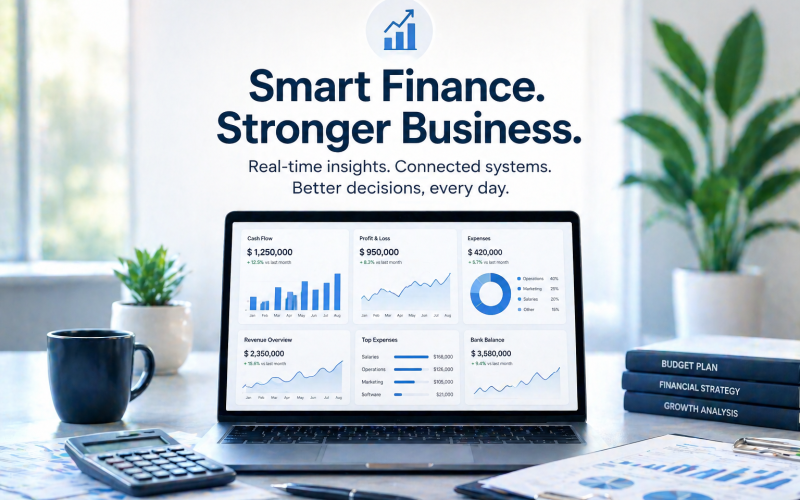


Efficient financial management is the backbone of every successful organization. It ensures operations run smoothly, data remains accurate, and decision-makers have the clarity they need to move forward with confidence.
Yet, traditional financial systems often struggle to keep up with the increasing complexity of modern business. Reporting cycles are slow, data is fragmented across systems, and risk management is reactive rather than proactive.
Artificial intelligence (AI) is changing this landscape.
From automating reporting processes to identifying financial risks in real time, AI is redefining how organizations manage their financial operations. It is not just making finance faster — it is making it smarter, more predictive, and more reliable.
The Limitations of Traditional Financial Systems
For years, financial reporting has relied heavily on manual processes and disconnected tools. Even with digital systems in place, many organizations still face challenges such as:
- Data scattered across multiple platforms
- Time-consuming reconciliation processes
- Delayed financial insights
- Increased risk of human error
These limitations slow down decision-making and make it difficult for organizations to respond quickly to changing conditions.
Risk management, in particular, suffers under these conditions. Without real-time visibility, risks are often identified too late, when corrective action becomes more difficult.
This is where AI introduces a fundamental shift.
Real-Time Financial Reporting
One of the most significant impacts of AI is the move from periodic reporting to real-time visibility.
Instead of waiting for end-of-month or quarterly reports, AI-powered systems can continuously process financial data and update reports instantly.
This enables organizations to:
- Monitor cash flow in real time
- Track expenses as they occur
- Identify anomalies immediately
- Make faster, data-driven decisions
Platforms like Synclo are increasingly built to support this real-time approach by centralizing financial data and enabling continuous tracking, eliminating the delays caused by fragmented systems.
Automating Complex Financial Processes
Financial operations involve a wide range of repetitive and complex tasks, including:
- Data entry
- Transaction classification
- Reconciliation
- Report generation
AI can automate these processes with high accuracy.
Machine learning models can categorize transactions, detect inconsistencies, and even generate financial summaries without manual intervention.
This reduces:
- Operational workload
- Human error
- Processing time
Systems such as Synclo integrate structured workflows with intelligent automation, allowing finance teams to focus less on manual tasks and more on analysis and strategy.
Smarter Risk Management Through Predictive Insights
Traditional risk management is often reactive. Issues are identified after they occur, leaving limited room for prevention.
AI shifts risk management from reactive to predictive.
By analyzing historical data and identifying patterns, AI can:
- Detect unusual financial behavior
- Predict potential cash flow issues
- Highlight compliance risks
- Identify fraud indicators
This allows organizations to act before risks escalate.
For example, platforms like Synclo provide centralized financial visibility, making it easier to monitor patterns and detect inconsistencies early, supporting more proactive risk management.
Improving Accuracy and Reducing Errors
Accuracy is critical in financial reporting. Even small errors can lead to significant consequences, including compliance issues and poor decision-making.
Manual processes increase the likelihood of errors, especially when data is handled across multiple systems.
AI improves accuracy by:
- Eliminating redundant data entry
- Validating transactions automatically
- Ensuring consistency across datasets
When combined with unified systems such as Synclo, where financial data is managed within a single environment, the risk of discrepancies is significantly reduced.
Enhancing Compliance and Audit Readiness
Regulatory requirements are becoming increasingly complex. Organizations must maintain accurate records, provide transparent reporting, and ensure audit readiness at all times.
AI helps simplify compliance by:
- Maintaining structured audit trails
- Automating documentation processes
- Monitoring compliance in real time
This reduces the effort required to prepare for audits and ensures that organizations remain aligned with regulatory standards.
Platforms like Synclo support this by keeping financial workflows structured and traceable, making compliance management more straightforward and less time-consuming.
Data-Driven Decision Making
Financial reporting is no longer just about recording past performance. It is about enabling better decisions for the future.
AI transforms financial data into actionable insights by:
- Identifying trends and patterns
- Forecasting future performance
- Highlighting areas of concern
This allows leadership teams to:
- Allocate resources more effectively
- Plan investments with confidence
- Respond quickly to market changes
With systems like Synclo providing centralized data and real-time visibility, decision-making becomes faster, more accurate, and more strategic.
The Role of Integration in Financial Systems
One of the biggest challenges in financial management is the lack of integration between systems.
Finance often operates separately from:
- HR systems
- Operational workflows
- Supply chain processes
This disconnect creates gaps in data and reduces overall efficiency.
The future of financial management lies in integrated systems where finance is connected with all other business functions.
Platforms like Synclo are designed to bring these functions together, ensuring that financial data is aligned with operational activities, improving both reporting and risk management.
Challenges and Considerations
While AI offers significant advantages, organizations must also address certain challenges:
- Ensuring data privacy and security
- Maintaining transparency in AI-driven decisions
- Avoiding over-reliance on automation
- Providing human oversight
AI should be seen as a tool to enhance financial management, not replace human judgment.
The most effective systems combine automation with human expertise.
The Future of Financial Reporting and Risk Management
The future of finance is intelligent, connected, and proactive.
AI will continue to drive advancements such as:
- Fully automated financial workflows
- Predictive risk management systems
- Real-time financial ecosystems
- Seamless integration across business functions
As organizations adopt these technologies, financial operations will become more agile, resilient, and scalable.
Conclusion
AI is transforming financial reporting and risk management in ways that were not possible with traditional systems.
By enabling real-time insights, automating processes, improving accuracy, and predicting risks, AI is helping organizations move from reactive management to proactive strategy.
Efficient financial management is no longer just about maintaining records. It is about ensuring operations run smoothly, data remains accurate, and decisions are made with confidence.
Platforms like Synclo reflect this shift by bringing financial workflows, data, and insights into one unified environment, supporting a more connected and intelligent approach to managing finance.
The future of finance is not just digital — it is intelligent.
