





- Employee training often fails due to lack of structure, visibility, and follow-through
- Training programs are disconnected from actual job performance and skill development
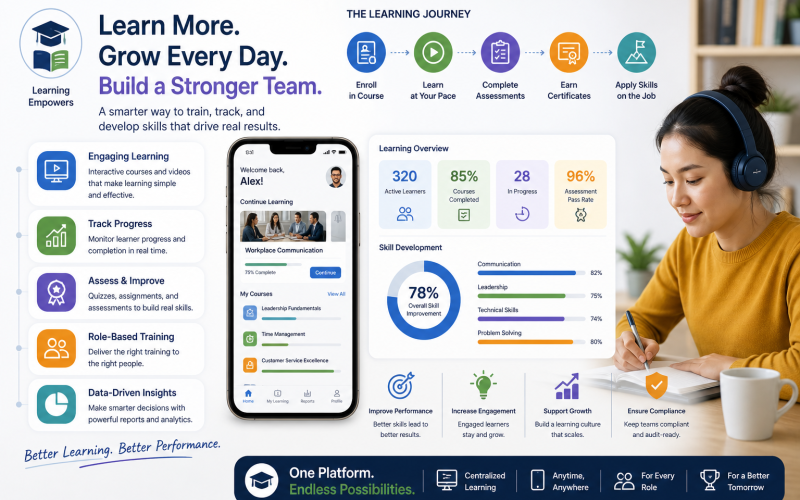
- Unified systems like Synclo help organizations train employees continuously and effectively

Employee training has become a standard part of modern organizations, but real skill development is still inconsistent. Companies invest in onboarding programs, assign courses, and build structured training paths, yet employees often struggle to apply what they learn in their actual roles.
The issue is not the availability of training. It is the gap between learning and execution.
Most training programs are designed to deliver information, not to ensure that information turns into capability. Employees complete modules, attend sessions, and move forward, but without reinforcement, most of that knowledge fades quickly.
Over time, training becomes routine. It exists, but it does not evolve with the employee.
Training Exists, But Growth Is Not Structured
In many organizations, training is treated as a one-time requirement rather than an ongoing process. New hires go through onboarding, teams complete periodic courses, and compliance training is handled separately.
Everything appears structured on the surface, but growth itself is not.
Employees are expected to improve, but there is often no clear system that tracks how their skills evolve over time. Learning is introduced in segments, without continuity or progression.
This leads to a common pattern where employees:
- complete training without gaining confidence in their skills
- repeat similar content without measurable improvement
- rely on experience alone rather than structured development
A modern learning management system (LMS software) needs to move beyond course delivery and create a continuous development environment.
Where Skill Development Starts Breaking Down
The biggest challenge in employee training is the disconnect from daily work. Training modules are often generic, while job roles are specific and dynamic.
Employees struggle to connect what they learn with what they are expected to do. Managers, on the other hand, have limited visibility into whether training is actually improving performance.
This disconnect creates friction across the organization. Training continues, but its impact remains unclear.
Without a system that connects learning to real tasks, development becomes inconsistent.
Synclo addresses this by linking training workflows with operational data, allowing organizations to track how learning translates into actual performance over time.
Practical Ways to Build Real Employee Skills
Closing the gap between training and skill development requires a shift in how organizations approach learning. Instead of focusing only on content, the focus needs to move toward application, reinforcement, and visibility.
A more effective approach includes:
- Embedding learning into daily workflows so employees apply skills immediately
- Creating role-specific learning paths instead of generic training modules
- Using real-time feedback loops to reinforce learning after each task or milestone
- Tracking skill progression over time rather than just course completion
- Aligning training with business goals so learning directly supports performance
These changes turn training into a continuous process rather than a periodic activity.
With systems like Synclo, these workflows can be structured within a single platform, making it easier to manage both learning and performance together.
Fragmented Systems Limit Learning Outcomes
Many organizations rely on multiple tools for training, assessments, and performance tracking. While each tool serves a purpose, they often do not connect effectively.
Employees move between platforms. Managers rely on separate reports. Data is scattered, making it difficult to get a complete view of progress.
This fragmentation reduces the effectiveness of training programs.
Organizations are now shifting toward:
- All-in-one learning management systems
- Centralized employee training platforms
- Integrated business systems that connect learning with operations
The goal is not just to simplify tools, but to create a connected environment where learning and work happen together.
Synclo enables this by integrating LMS functionality with broader operational systems, reducing the gaps that typically slow down development.
Continuous Learning Requires Continuous Visibility
One of the most important elements of effective training is visibility. Without it, organizations cannot measure progress or identify gaps.
Completion rates alone are not enough. What matters is how training impacts performance over time.
A connected employee training software environment provides deeper insights into learning behavior, skill progression, and outcomes.
This allows organizations to:
- identify which skills are improving and which are not
- adjust training programs based on real data
- ensure that learning is aligned with business needs
Synclo supports this by connecting training data with performance metrics, enabling better decision-making around employee development.
Scaling Skill Development Across the Organization
As companies grow, training becomes more complex. Different roles require different skills, and maintaining consistency across teams becomes challenging.
Without a scalable system, training programs become uneven. Some teams progress faster, while others fall behind. Content may become outdated, and tracking becomes less reliable.
A scalable business system ensures that skill development remains structured as the organization expands. It provides a consistent framework for training, regardless of team size or location.
Synclo enables this by offering a flexible platform that adapts to organizational growth while maintaining alignment across all training activities.
What Effective Training Actually Looks Like
When training systems are aligned with real work, the impact becomes visible. Employees gain confidence in their roles because they are applying what they learn. Managers can track development without relying on assumptions. Learning becomes part of the workflow rather than a separate task.
The shift is subtle but powerful. Training stops being something employees complete and becomes something they experience.
This is where modern organizations are heading. Not toward more content, but toward better systems that connect learning, performance, and growth.
Because in the end, skill development is not about how much employees learn. It is about how effectively they apply it.
