


- Construction finance becomes difficult when budgets, procurement, invoices, and project costs are tracked separately.
- Manual reporting slows visibility into cash flow, cost overruns, and profitability.
- Connected finance systems help construction businesses control spending and manage projects with better financial clarity.
Construction and real estate businesses operate with constant financial pressure. Every project involves budgets, vendors, materials, labor costs, equipment expenses, subcontractor payments, client billing, approvals, and cash flow planning. When these financial activities are not connected, project leaders struggle to understand actual performance until delays or cost overruns have already affected the business.
Many construction companies still manage finance through separate spreadsheets, accounting tools, procurement records, and project reports. Each department may track its own numbers, but the business often lacks one complete view of project finances. This creates a gap between planned budgets and actual spending, making it difficult to make confident decisions while projects are still active.
The issue is not that construction businesses lack financial data. The issue is that the data is often scattered across too many places. When finance teams, procurement teams, and project managers work from different records, reporting becomes slow and accuracy becomes harder to maintain.
Project Budgets Need Real-Time Visibility
Construction budgets change frequently as projects move forward. Material prices shift, scope changes occur, subcontractor costs increase, and unexpected site requirements appear. If teams rely on delayed reports, they may not see budget pressure until it becomes a major issue.
This often creates:
- Late identification of cost overruns
- Difficulty tracking actual expenses against planned budgets
- Limited visibility into project profitability
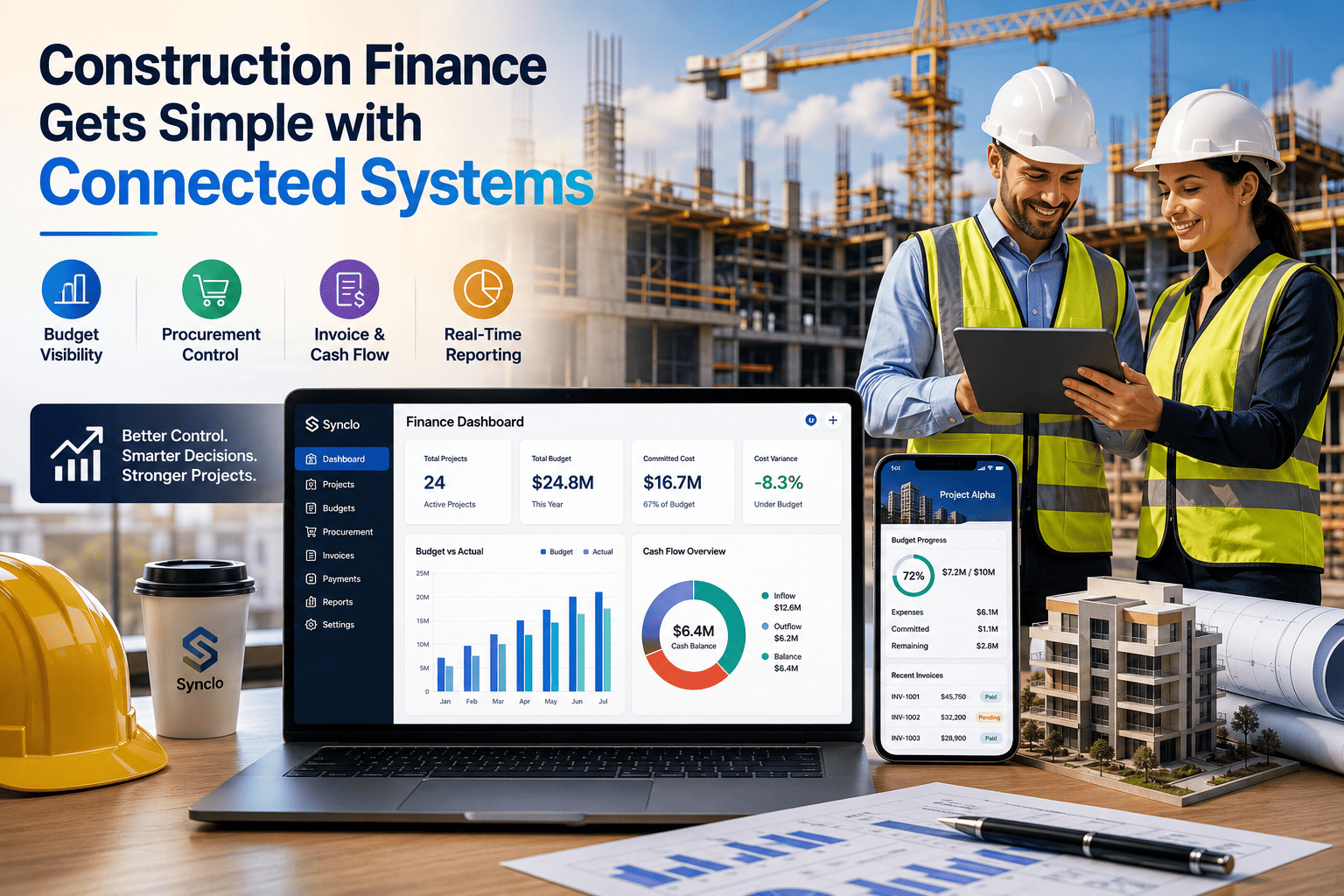
A connected financial management system helps construction teams track budgets, approvals, expenses, and project costs in one place. Synclo supports this by connecting finance workflows with procurement and project operations, allowing teams to monitor financial activity as it happens.
Procurement and Finance Must Work Together
Procurement decisions directly affect project finances. Every purchase order, supplier payment, and material request influences cost control. When procurement and finance operate separately, delays and mismatches become common.
A project team may approve a purchase without full budget visibility, while finance teams may receive payment requests without enough operational context. This creates unnecessary back-and-forth and slows the approval process.
A connected finance system links procurement activity with budget control, helping teams manage spending with better accuracy. This improves accountability and reduces the risk of unplanned expenses.
Manual Invoicing Slows Cash Flow
Cash flow is critical in construction. Delayed invoices, late approvals, and manual billing processes can create financial strain, especially across long project timelines.
Many businesses still depend on manual invoice tracking, email approvals, and spreadsheet-based billing records. These processes are time-consuming and increase the chance of missed updates.
Modern construction companies are moving toward:
- Automated invoice workflows
- Connected billing and payment tracking
- Real-time cash flow visibility
The goal is to reduce delays and give finance teams a clearer view of money moving in and out of the business.
Cost Control Depends on Accurate Reporting
Construction leaders need accurate reporting to understand whether a project is profitable. However, if data comes from multiple systems, reports take longer to prepare and may not reflect current conditions.
A connected finance platform allows teams to view project costs, vendor payments, procurement activity, and billing status from one environment. This makes financial reporting faster and more reliable.
Synclo helps construction businesses reduce manual reporting effort by bringing financial and operational data together into structured workflows.
Scaling Construction Finance Requires Connected Systems
As construction businesses grow, financial complexity increases. More projects, more vendors, more approvals, and more transactions create pressure on finance teams. Without a connected system, financial control becomes harder to maintain.
A scalable construction finance platform helps businesses manage growth without losing visibility. Teams can track project costs, budgets, invoices, procurement, and financial reporting through one connected environment.
When finance systems are connected, construction businesses gain stronger control over spending, profitability, and cash flow. Project teams make better decisions, finance teams reduce manual work, and leadership gains clearer visibility into business performance.
