


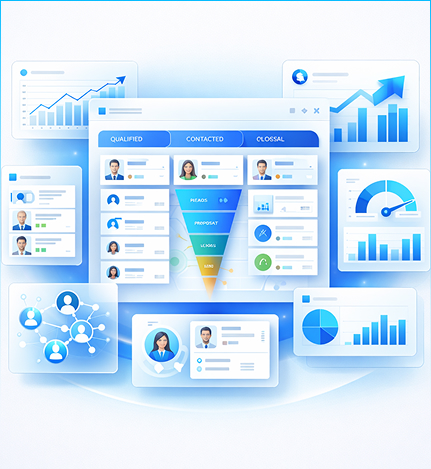




- Sales today is shaped less by process and more by how buyers behave across fragmented journeys
- The real challenge isn’t closing deals—it’s maintaining clarity across an unpredictable pipeline
- Businesses that unify systems and data are gaining a measurable advantage in execution and forecasting

Sales has not become more difficult. It has become less predictable.
For a long time, sales teams operated within a structure they could rely on. Leads came in, were qualified, moved through a defined pipeline, and eventually closed. The process was linear, measurable, and, most importantly, controllable.
That sense of control has gradually disappeared.
Today’s buyers behave differently. They research independently, compare options across multiple platforms, involve more stakeholders, and often enter the sales process long before a sales team is even aware of them. By the time a conversation begins, the traditional “start of the funnel” is already behind them.
This shift has fundamentally changed how sales teams need to operate. It is no longer enough to follow a predefined sequence of steps. The modern sales environment requires a system that adapts in real time, one that reflects how deals actually move rather than how they are supposed to move.
At the center of this change is the growing importance of CRM software and connected systems that provide visibility into every stage of the pipeline. Without that visibility, sales becomes reactive, fragmented, and difficult to scale.
The Breakdown of the Traditional Pipeline
The idea of a clean, predictable pipeline still exists in theory, but in practice, it rarely holds.
Deals do not move neatly from one stage to another. They stall, accelerate, loop backward, or disappear entirely before resurfacing later. What appears as inactivity is often simply movement happening outside of the system.
This creates a gap between what sales teams see and what is actually happening.
That gap is where opportunities are lost.
In many organizations, pipeline data is still updated manually. This introduces delays, inconsistencies, and, in some cases, inaccuracies that distort the true picture of sales performance. Leadership decisions are then made based on incomplete information, which compounds the problem.
A modern sales CRM software addresses this by capturing activity in real time and aligning it with actual deal movement. When integrated into a broader cloud-based ERP system, this visibility extends beyond sales into finance and operations, allowing businesses to understand not just what is closing, but how it impacts the organization as a whole.
Fragmentation Is the Real Sales Problem
It is easy to assume that sales challenges are caused by market conditions, competition, or buyer behavior. While those factors play a role, the more persistent issue lies inside the organization itself.
Sales teams today operate across multiple tools. Customer data lives in one system, communication happens in another, reporting is handled elsewhere, and forecasting is often done in spreadsheets. Each system serves a purpose, but together they create fragmentation.
This fragmentation makes alignment difficult.
When data is not centralized, different teams begin working with different assumptions. Sales may believe a deal is progressing, while finance questions the revenue forecast. Operations may be unaware of commitments made during the sales process. The result is not just inefficiency, but a lack of trust in the system itself.
This is why businesses are increasingly moving toward all-in-one business software and integrated ERP systems. The goal is not simply to consolidate tools, but to create a unified environment where data flows consistently across the organization.
Synclo operates within this model by connecting sales, finance, and operations into a single system, reducing the friction that comes from disconnected workflows.
The Importance of Real-Time Sales Visibility
One of the defining characteristics of modern sales organizations is the need for real-time insight.
In previous models, reporting cycles were acceptable. Weekly updates and monthly reviews provided enough information to guide decisions. That is no longer the case.
Sales cycles have shortened in some industries and become more complex in others. Either way, waiting for delayed reports introduces risk. Opportunities can be missed, deals can stall without detection, and pipeline issues can go unnoticed until they become significant.
Real-time visibility changes this dynamic.
When sales leaders can see the current state of the pipeline at any moment, they can intervene earlier, allocate resources more effectively, and make adjustments before problems escalate. This level of responsiveness is only possible when systems are connected and continuously updated.
With platforms like Synclo, sales data is not isolated. It is part of a broader operational view that includes financial impact, resource allocation, and customer activity. This creates a more accurate and actionable understanding of the business.
Automation as an Operational Layer
Automation has become a central part of modern sales systems, but its role is often misunderstood.
It is not about replacing human interaction. It is about removing unnecessary friction.
Sales teams spend a significant amount of time on tasks that do not directly contribute to closing deals. Updating records, setting reminders, generating reports, and coordinating across teams all take time away from actual selling.
Automation addresses this by handling repetitive processes in the background.
When implemented correctly, end-to-end business automation allows sales teams to focus on high-value activities. Follow-ups happen at the right time, data updates automatically, and workflows move forward without manual intervention.
This is where integrated platforms provide an advantage. Instead of automating isolated tasks, they automate entire processes across departments. Synclo enables this by connecting sales workflows with operational and financial systems, ensuring that automation supports the entire business, not just one function.
Sales and Revenue Are Now Deeply Connected
One of the most significant changes in recent years is the alignment between sales and revenue operations.
Sales is no longer just responsible for closing deals. It plays a direct role in shaping revenue predictability, cash flow, and financial planning. This requires a level of coordination that traditional systems were not designed to support.
Forecasting, for example, has historically been one of the least reliable aspects of sales. It often depends on subjective judgment and incomplete data. As a result, forecasts can vary widely from actual outcomes.
Modern systems are beginning to change this.
With better data integration and the introduction of AI-powered business management, forecasting is becoming more accurate and more dynamic. Patterns can be identified, risks can be highlighted, and projections can be adjusted in real time.
Synclo supports this shift by aligning sales data with financial data, creating a more consistent and reliable view of revenue performance.
Scaling Sales Without Losing Structure
Growth introduces complexity, and complexity tests systems.
As sales teams expand, the number of deals increases, communication becomes more difficult, and maintaining consistency becomes a challenge. Without the right infrastructure, this leads to disorganization and inefficiency.
A scalable business system is essential for maintaining control as the organization grows.
This does not simply mean handling more data. It means maintaining clarity, consistency, and visibility even as operations become more complex.
Modern ERP platforms provide this foundation by standardizing processes and integrating data across the organization. Synclo enables businesses to scale their sales operations while preserving the structure needed for effective execution.
Where Sales Is Heading
Sales is moving toward a model that is less dependent on individual effort and more dependent on systems.
The most effective teams are not necessarily the ones that work the hardest. They are the ones that operate within systems that provide clarity, reduce friction, and support decision-making.
This shift is not about replacing human judgment. It is about enhancing it.
When systems provide accurate, real-time information, sales teams can make better decisions. When workflows are automated, they can focus on what matters. When data is unified, the entire organization becomes more aligned.
The modern sales playbook is not a document. It is a system.
And the businesses that understand this are the ones that will continue to grow, adapt, and compete effectively in the years ahead.
