




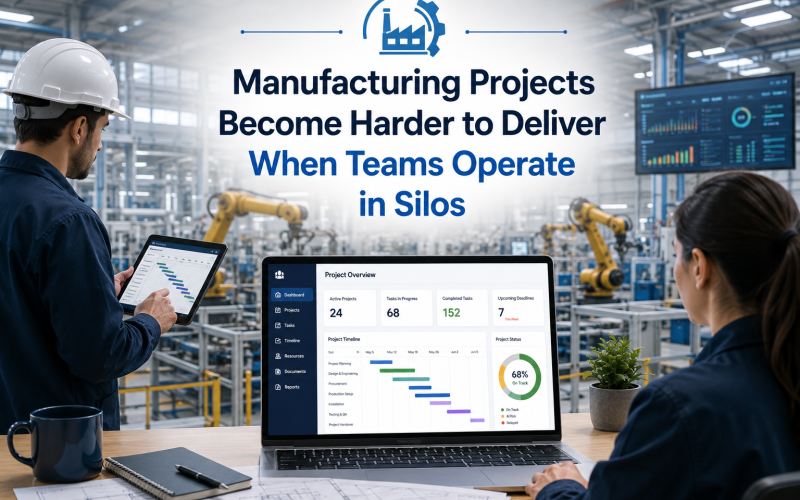

- Project status becomes unreliable when task completion is tracked without the dependencies, decisions, risks, and approvals surrounding the work.
- Project orchestration connects planning with real execution so teams can identify blocked work and adjust priorities before deadlines are missed.
- Synclo helps technology teams coordinate tasks, resources, documents, approvals, and project intelligence within one connected environment.
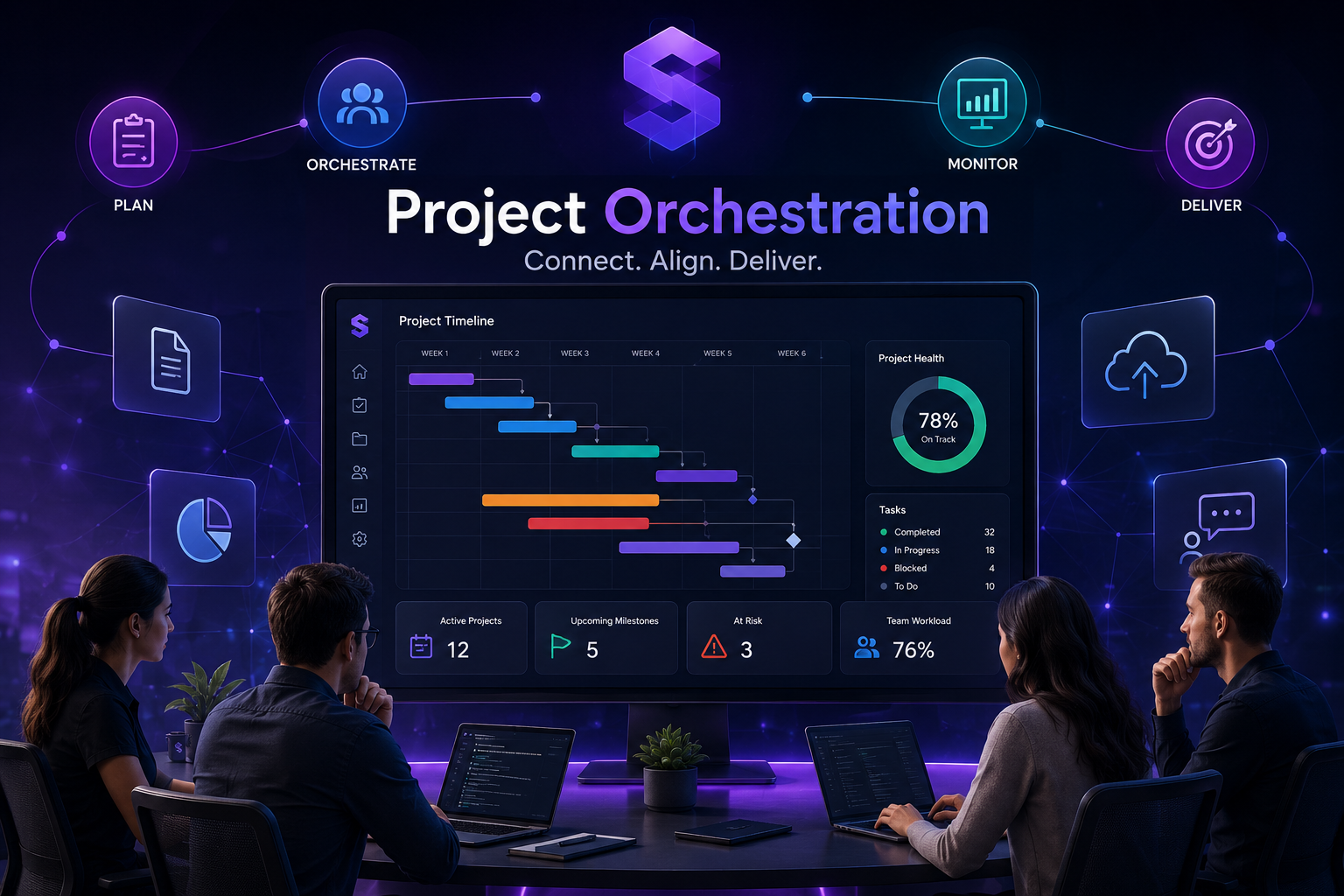
Project management software made work easier to organize. Teams could create tasks, assign owners, set deadlines, attach documents, and track progress through boards, lists, and timelines. These tools replaced many spreadsheets and gave managers a more consistent view of planned work.
However, organizing tasks is not the same as managing execution.
Technology projects rarely fail because nobody created a task. They fail because dependencies are discovered too late, priorities change without reaching every team, decisions remain pending, resources become unavailable, and important risks remain hidden behind apparently healthy progress reports.
A project board may show that most tasks are complete while one unresolved dependency threatens the entire release. A milestone may appear on schedule even though the approval required to begin the next phase has not been received. A development team may complete its assigned work while security, infrastructure, or client teams remain unprepared.
Traditional task management records individual activities. Project orchestration connects those activities with the decisions, resources, dependencies, risks, and business outcomes that determine whether the project can actually move forward.
Task Completion Does Not Always Represent Project Progress
Task-based systems usually calculate progress through completed work. If eight out of ten tasks are finished, the project may appear to be 80 percent complete.
That calculation can be misleading.
The two remaining tasks may contain the most difficult technical work. One may require client approval, while the other blocks deployment. Several completed tasks may need to be revised after a requirement changes.
Projects do not progress evenly. Different activities carry different levels of impact, uncertainty, and dependency.
A more reliable project view considers:
- Which deliverables have been completed
- Which dependencies remain unresolved
- Whether critical decisions have been made
- Whether required resources are available
- Which risks could affect the next milestone
- Whether completed work has passed review
- Whether the project outcome remains achievable
This creates a more honest view of progress than a simple count of closed tasks.
Dependencies Create the Real Project Structure
Technology projects are built through connected work.
A developer cannot begin integration until an API is available. Quality assurance cannot complete testing until the environment is stable. Deployment cannot proceed until security and change approvals are complete. A client cannot review the product until the correct version has been released.
These relationships form the real structure of the project.
Traditional task lists may record dependencies, but teams often manage them informally. Employees mention blockers during meetings, send reminders through chat, or add comments beneath individual tasks. The dependency exists, but it may not be visible in the wider project plan.
Project orchestration treats dependencies as active operational signals.
When an upstream task changes, the system can identify the downstream work affected by that change. Project managers can then review whether deadlines, resources, or priorities need adjustment.
The purpose is not to create a more complicated plan. It is to help teams understand the consequences of a change before those consequences appear as missed deadlines.
Project Plans Need to Adapt to Live Conditions
A project plan represents the best available understanding at a specific moment. Once execution begins, conditions change.
A customer adds a requirement. An employee becomes unavailable. A vendor changes a delivery date. A technical assumption proves incorrect. A security issue requires additional work.
Static project plans struggle with these changes because updates often happen at the task level without revisiting the wider project logic.
One deadline moves, but dependent tasks keep their original dates. New work is added, but resource capacity remains unchanged. A priority changes during a meeting, while team members continue working from the previous plan.
Project orchestration creates a more responsive model. Changes can be assessed according to their effect on:
- Project scope
- Milestones
- Dependencies
- Team capacity
- Budget
- Risk
- Client commitments
- Other active projects
This helps managers make deliberate trade-offs instead of silently adding more work to the same schedule.
Decisions Are Part of the Project Plan
Many project delays are actually decision delays.
A technical approach requires approval. A client must confirm the design. Finance must approve additional cost. Leadership must choose between scope, time, and budget options.
These decisions may appear in meeting notes or email threads without becoming visible project activities.
The plan continues to show the next task as scheduled even though the team cannot begin until the decision is made.
Decision management should therefore be part of project management.
Every important decision should identify:
- The question requiring resolution
- The options being considered
- The information needed
- The responsible decision-maker
- The required decision date
- The work affected by the outcome
- The final choice and supporting rationale
This creates a traceable decision history while making pending approvals visible alongside tasks and milestones.
Teams can then distinguish between work that is delayed because of execution and work that is waiting for direction.
Project Meetings Should Manage Exceptions
Status meetings often require every participant to repeat what they completed, what they are doing next, and whether they have blockers.
This format consumes time even when most work is progressing normally. Important issues may receive only a few minutes after routine updates fill the meeting.
A connected project system should already contain standard progress information. Meetings can then focus on exceptions requiring collective attention.
Useful discussion areas include:
- Critical dependencies at risk
- Decisions that require escalation
- Tasks with no clear owner
- Milestones affected by new scope
- Resource conflicts across projects
- Risks whose probability or impact has changed
- Client commitments that may no longer be realistic
This changes the meeting from a reporting exercise into a decision forum.
Employees spend less time explaining activity, while managers can concentrate on the conditions that may change the outcome.
Resource Capacity Must Be Connected to Project Demand
Project plans often assume that assigned employees will remain available for the duration of the work. In reality, technology teams support several projects, operational issues, customer requests, meetings, and internal responsibilities at the same time.
An employee may be assigned to several projects at partial capacity. However, each manager may plan as though that capacity is fully available.
The conflict becomes visible only when deadlines begin to slip.
Project orchestration connects project demand with realistic workforce capacity. Managers can see:
- Current assignments
- Planned availability
- Leave and absence
- Required skills
- Competing project commitments
- Operational support workload
- Future capacity gaps
This does not mean every hour must be scheduled in detail. Excessive planning creates administrative effort and quickly becomes outdated.
The objective is to identify meaningful capacity conflicts before work is committed.
Cross-Project Dependencies Need Portfolio Visibility
Technology businesses rarely manage one project at a time. A product release may depend on an infrastructure upgrade. A client implementation may depend on a shared integration team. Several projects may require the same technical specialist during the same period.
Individual project plans cannot show the complete effect of these conflicts.
Portfolio visibility allows leaders to review projects as a connected system rather than separate schedules.
They can identify:
- Teams overloaded across several projects
- Projects competing for the same specialist
- Shared dependencies affecting multiple deadlines
- Initiatives with weak strategic value
- Projects continuing without clear ownership
- Work that should be delayed, combined, or stopped
This creates better prioritization.
Organizations often try to solve delivery problems by asking teams to work faster. In many cases, the real issue is that too many initiatives are active at the same time.
Project orchestration helps leadership manage the volume and sequence of work, not only the execution of each individual project.
Risks Should Change the Plan Before They Become Issues
Risk registers are often created during project planning and reviewed periodically. Risks receive descriptions, probability ratings, impact levels, and mitigation actions.
However, the risk record may remain separate from daily work.
A project identifies dependency on a vendor, but no alert appears when the vendor misses an intermediate milestone. A resource risk is recorded, but the schedule does not change when the specialist becomes unavailable.
Effective risk management connects warning signals with project activity.
A risk should influence the plan when its conditions begin to change.
For example:
- A delayed vendor deliverable can raise the risk level
- Repeated failed tests can affect release confidence
- Increased defect volume can add quality work
- Unresolved requirements can reduce estimation reliability
- Resource overload can threaten upcoming milestones
- Slow client decisions can affect implementation dates
The system can surface these changes, while project managers decide whether to adjust the plan, escalate the issue, or accept the risk.
AI Can Reduce Project Coordination Work
Project managers spend considerable time maintaining information. They collect updates, prepare summaries, review overdue tasks, identify blockers, organize meeting notes, and remind people about commitments.
AI can support this work by organizing project information and identifying patterns that would otherwise require manual review.
Useful applications include:
- Summarizing recent project activity
- Identifying tasks without current updates
- Highlighting possible dependency conflicts
- Preparing meeting agendas from active exceptions
- Extracting decisions and actions from meeting notes
- Detecting milestones at risk
- Drafting stakeholder status reports
- Comparing current execution with the original plan
- Identifying repeated blockers across projects
AI should not decide project priorities or commit the organization to new deadlines without human review.
Project managers understand stakeholder relationships, technical uncertainty, organizational politics, and business trade-offs that may not appear in the system data.
The strongest model uses AI to reduce information-processing work while keeping managers responsible for judgment and communication.
Project Health Needs More Than Red, Amber, and Green
Project health is often reduced to a color. Green means on track, amber means at risk, and red means delayed.
These indicators are easy to understand but can hide important detail.
One manager may mark a project green because the deadline has not changed. Another may mark a similar project amber because a technical risk has increased. The colors depend heavily on personal interpretation.
A stronger health model reviews several dimensions:
- Schedule confidence
- Scope stability
- Resource capacity
- Budget position
- Dependency health
- Risk exposure
- Quality performance
- Stakeholder decisions
- Team workload
The system can show which dimensions are weakening even when the overall project remains on track.
This allows leadership to intervene earlier. A project does not need to become red before it deserves attention.
How Synclo Supports Project Orchestration
Synclo Project Management connects projects, tasks, milestones, resources, documents, approvals, risks, discussions, and reporting in one operational environment.
Teams can maintain clear ownership while linking work with the dependencies and decisions that affect execution. Project managers can review overdue actions, blocked tasks, pending approvals, resource demand, and milestone health without collecting updates from separate tools.
Because Synclo also connects workforce, finance, supply chain, documents, help desk, and broader business operations, projects can operate with stronger organizational context.
A project task can connect to a purchase request. A resource assignment can reflect employee availability. An approval can update dependent work. A support issue can become a project risk when it affects delivery.
AI integration can help summarize activity, identify exceptions, prepare status updates, and surface work that may require intervention.
The project manager remains responsible for decisions. The system helps ensure those decisions are based on current, connected information.
Project Management Is Becoming a Coordination Discipline
Task management will remain part of project delivery. Teams still need to know what must be completed, who owns it, and when it is due.
However, modern projects need more than organized task lists.
They need a system that connects changing priorities, decisions, risks, dependencies, resources, and business outcomes. They need visibility into what is blocking progress and what will be affected when the plan changes.
Project orchestration creates this connected execution model.
It helps organizations move beyond asking whether tasks are complete and toward understanding whether the project is still capable of delivering the intended result.
The future of project management is not a larger board with more tasks. It is a connected operating system that helps work, information, and decisions move together.
