





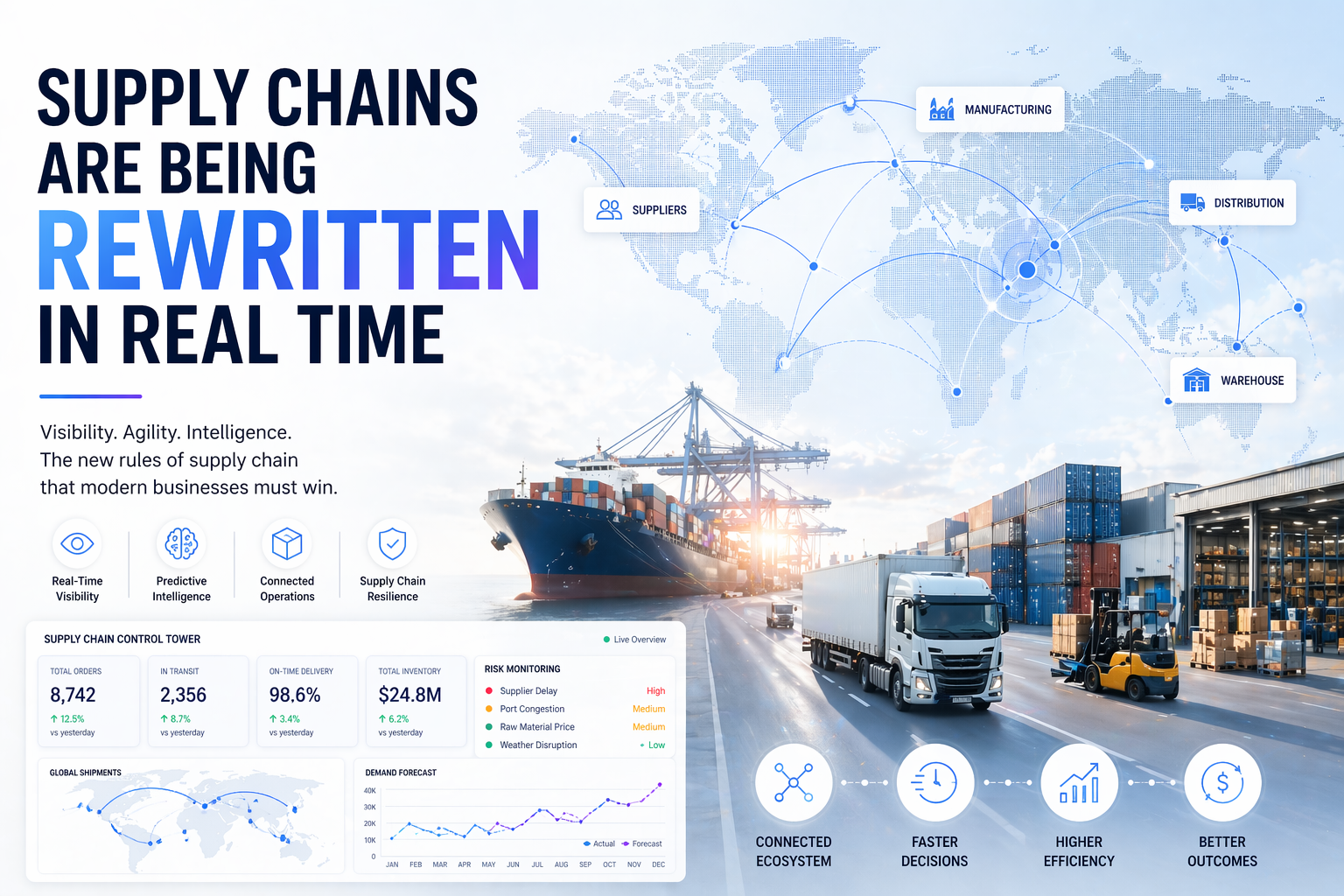
- Supply chains are shifting from efficiency-first to resilience and real-time visibility
- Fragmented systems and lack of integration are the biggest causes of delays and inefficiencies
- Unified platforms like Synclo enable connected, intelligent, and scalable supply chain operations
For decades, supply chains followed a predictable model.
- Source materials at the lowest cost.
- Produce at scale.
- Distribute efficiently.
That model defined global commerce. It rewarded efficiency, lean operations, and cost optimization.
But that model is breaking.
In 2026, supply chains are no longer stable systems. They are dynamic, constantly shifting networks that must respond to disruptions, demand fluctuations, and operational complexity in real time.
What used to be a back-end function is now one of the most critical drivers of business performance.
And the rules are being rewritten.
The Collapse of the Efficiency-First Model
The traditional supply chain was built for a world that no longer exists.
It assumed:
-
- predictable demand
- stable supplier networks
- consistent logistics timelines
But today’s reality is different.
Businesses are facing:
-
- sudden supplier disruptions
- volatile raw material costs
- shifting customer demand
- geopolitical uncertainty
In this environment, optimizing for cost alone creates fragile systems.
A single delay in procurement can halt production.
A missed shipment can disrupt entire distribution cycles.
Efficiency without flexibility has become a liability.
This is why companies are moving toward supply chain management software that prioritizes adaptability and visibility, not just cost control.
Why Visibility Has Become Non-Negotiable
If there is one capability defining modern supply chains, it is visibility.
Not just tracking shipments.
Not just monitoring inventory.
But understanding the entire flow of operations in real time.
Businesses need to know:
-
- where materials are
- what inventory levels look like
- how suppliers are performing
- what risks are emerging
Without this visibility, decisions are delayed. And in supply chain operations, delays are expensive.
Traditional tools fail here because they operate in silos.
Procurement systems don’t talk to inventory.
Inventory doesn’t align with logistics.
Finance receives updates after everything has already happened.
This is why businesses are shifting toward all-in-one ERP software and centralized business operations software that unify supply chain data into a single system.
Platforms like Synclo enable this by connecting procurement, inventory, logistics, and finance—turning fragmented data into actionable intelligence.
The Hidden Cost of Disconnected Systems
Most supply chain inefficiencies are not caused by external disruptions.
They are caused by internal fragmentation.
Different teams operate using different tools:
-
- procurement uses one system
- warehouse teams use another
- finance relies on separate accounting software
This creates multiple versions of reality.
A procurement team may think inventory is low.
The warehouse may have surplus stock.
Finance may not have updated cost data.
This misalignment leads to:
-
- over-ordering or under-ordering
- delayed production
- inaccurate financial planning
The problem is not a lack of tools. It is too many disconnected tools.
This is driving the shift toward ERP CRM HRMS combined software and integrated ERP systems that eliminate silos and create a single source of truth.
Inventory Is Now a Strategic Asset
Inventory is no longer just an operational metric. It is a financial and strategic asset.
Every unit of inventory represents:
- tied-up capital
- potential revenue
- operational risk
Too much inventory increases costs.
Too little inventory disrupts production.
Managing this balance has become more complex as demand patterns become unpredictable.
Modern inventory management software provides real-time tracking and automated updates, helping businesses maintain optimal stock levels.
With platforms like Synclo, inventory is no longer managed in isolation. It is connected to procurement, production, and finance—ensuring that every decision is aligned across the business.
The Shift Toward Real-Time Decision Making
In the past, supply chain decisions were made based on periodic reports.
Weekly updates.
Monthly reviews.
That approach no longer works.
Supply chains now operate in real time.
Decisions must happen just as fast.
Businesses need to:
- reroute shipments instantly
- adjust inventory dynamically
- respond to supplier disruptions immediately
This requires systems that provide continuous updates, not delayed insights.
A cloud-based ERP system enables this by synchronizing data across departments in real time.
Synclo operates within this real-time layer, allowing businesses to act the moment something changes.
AI Is Redefining Supply Chain Intelligence
Artificial intelligence is no longer a future concept in supply chain management. It is becoming a practical necessity.
Not as a replacement for human decision-making, but as an enhancement.
AI enables:
- demand forecasting based on real-time trends
- early detection of disruptions
- optimization of inventory levels
- analysis of supplier performance
The real value of AI is prediction.
Knowing what might happen before it does.
With AI-powered business management, platforms like Synclo help businesses move from reactive operations to proactive strategies.
Scaling Supply Chains Without Breaking Them
Growth introduces complexity.
More suppliers.
More locations.
More transactions.
Without the right systems, this complexity leads to inefficiency.
Processes slow down.
Errors increase.
Coordination becomes difficult.
This is why scalability is becoming a key requirement for supply chain systems.
A scalable business system ensures that operations can grow without losing efficiency or control.
Modern ERP platforms provide this scalability by automating workflows and integrating data across the organization.
Synclo is designed to support this growth, enabling businesses to expand operations while maintaining clarity and control.
The Move Toward Unified Supply Chain Platforms
The future of supply chain management is not about adding more tools.
It is about unifying them.
Businesses are adopting:
- all-in-one business management software
- end-to-end business automation
- cross-department workflow automation
These systems bring together:
-
- procurement management software
- inventory management software
- logistics tracking
- financial management systems
The result is a connected environment where data flows seamlessly across departments.
This is where Synclo fits in—not as another tool, but as a platform that connects the entire supply chain with the rest of the business.
Supply Chain as a Competitive Advantage
Supply chains are no longer just operational functions.
They are competitive differentiators.
Companies that can:
-
- respond faster
- adapt quicker
- operate with greater visibility
gain a significant advantage.
This is especially important in industries like:
-
- manufacturing
- retail and e-commerce
- healthcare and pharma
Where supply chain performance directly impacts customer experience and business outcomes.
Final Thoughts
Supply chains are being rewritten—not gradually, but continuously.
The businesses that succeed in this new environment will not be the ones with the lowest costs.
They will be the ones with the highest visibility, the fastest decision-making, and the most connected systems.
Disconnected tools and outdated processes cannot support this level of complexity.
The future belongs to unified systems that bring everything together.
Platforms like Synclo enable businesses to:
-
- connect operations
- gain real-time visibility
- reduce inefficiencies
- scale with confidence
Because in a world where supply chains are constantly evolving,
the ability to see, adapt, and act in real time is the real advantage.
