




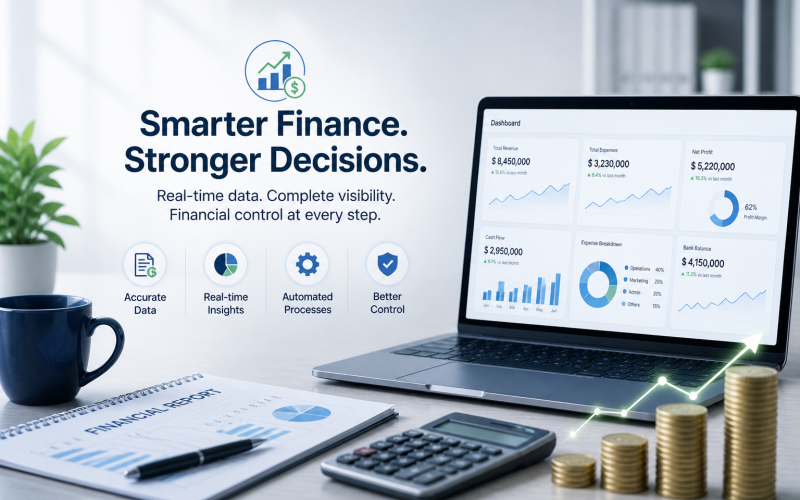



- Nonprofits need financial systems that separate restricted funding, program costs, and operating expenses clearly.
- Manual records make grant reporting, cash-flow planning, and audit preparation harder than necessary.
- Connected finance software gives leadership and boards a current view of funds, spending, and program performance.
Nonprofit accounting is not simply business accounting with different labels. A commercial company mainly tracks revenue, expenses, assets, liabilities, and profit. A nonprofit must also explain where money came from, what conditions apply to it, which program used it, and whether the spending matched donor or grant requirements.
That additional responsibility creates pressure for finance teams. Donations may arrive with specific instructions. Grants may cover only approved expenses. Programs may operate across different locations. Staff may divide their time between several initiatives. Leadership still needs enough unrestricted cash to pay salaries, rent, software, utilities, and other operating costs.
These demands are difficult to manage through spreadsheets and separate accounting records. The numbers may eventually balance, but teams can still lack a clear view of which funds are available, which expenses belong to each program, and what must be reported to funders.
The following five challenges appear often in nonprofit finance. Each one can be managed more effectively with clearer policies, consistent records, and a connected financial management system.
1. Keeping Restricted and Unrestricted Funds Separate
One of the most important nonprofit accounting tasks is identifying whether funding carries donor or grant restrictions. Some contributions can support general operations. Others must be used for a named program, activity, location, or period.
Problems begin when every receipt enters the same general account without enough detail. The organization may appear to have enough cash overall, even though a large part of that cash cannot be used for routine operating expenses. A team could then spend restricted money on an unapproved cost without realizing it.
A clear fund structure should identify:
- The source of each contribution or grant
- The purpose attached to the funding
- The program or project allowed to use it
- The period during which it can be spent
- The amount used and the balance remaining
The bank balance alone cannot answer these questions. Finance teams need records that separate cash availability from spending permission.
A connected finance system can assign funds, projects, departments, and restrictions to each transaction. This gives teams a current view of available resources without rebuilding the analysis manually at the end of every month.
2. Tracking Program Costs Accurately
Nonprofits need to understand how much each program costs to deliver. This information supports budgeting, grant reporting, board oversight, fundraising, and future planning.
Direct costs are usually easier to identify. Supplies purchased for a food distribution program clearly belong to that program. A trainer hired for a specific workshop can also be recorded against the relevant initiative.
Shared costs are harder. Rent, administration, technology, insurance, finance staff, and management time may support several programs at once. If the organization does not use a consistent allocation method, program reports may become unreliable.
The goal is not to push every expense into a program. It is to apply a documented method that reflects how resources are actually used. Common allocation bases include staff time, floor space, participant numbers, transaction volume, or direct program spending.
Organizations should define their cost-allocation approach before reporting deadlines. The same rules should be applied consistently unless operating conditions change.
Finance software can support this process by attaching departments, projects, grants, and cost centers to transactions. Recurring allocation rules can also reduce repeated spreadsheet work and make the method easier to review.
3. Managing Grant Reporting Without Last-Minute Work
Grants often come with detailed reporting requirements. A funder may request spending by category, progress against budget, supporting documents, remaining balances, or proof that costs were incurred during the approved period.
Many nonprofits wait until a reporting deadline approaches before collecting this information. Finance staff then search through invoices, bank records, payroll files, emails, and program spreadsheets to rebuild the grant history.
This process takes time and creates avoidable risk. A missing document or incorrectly coded expense may delay the report. Program teams may also remember activities differently from how the finance records describe them.
Grant reporting works better when each transaction is coded correctly at the time it enters the system. The record should connect the expense to the relevant grant, program, budget category, and supporting document.
A practical grant accounting workflow should include:
- A separate record for each funding agreement
- Approved budget categories and spending limits
- Start and end dates
- Required approvals
- Supporting documents
- Reporting deadlines
- Remaining balances
With this structure, reporting becomes a review process rather than a reconstruction exercise. Managers can also see whether spending is moving too quickly, too slowly, or outside the approved plan before the reporting period ends.
4. Understanding Cash Flow When Funding Is Uneven
A nonprofit can appear financially stable on paper and still face difficulty paying routine expenses. This happens because income and cash do not always arrive at the same time.
A grant may be approved but paid in stages. A reimbursement agreement may require the nonprofit to spend money before receiving funds. Annual donations may arrive during a short campaign, while salaries and rent continue every month.
Restricted cash can create another problem. The organization may have money in the bank, but those funds may not be available for payroll or administration.
A standard income and expense report does not provide enough information for this situation. Leadership needs a cash-flow view that separates:
- Current cash in the bank
- Restricted balances
- Expected grant payments
- Outstanding donor commitments
- Unpaid invoices and payroll obligations
- Planned program spending
- Available operating reserves
Rolling cash-flow forecasts are more useful than a budget that is reviewed only once or twice a year. Teams should update expected receipts and payments regularly, then compare the forecast with actual activity.
A connected finance platform can combine bank activity, grant schedules, receivables, payables, payroll, and planned expenses. This gives decision-makers a more realistic view of what the organization can fund now and what may require action later.
5. Preparing Reliable Reports for Boards, Donors, and Auditors
Nonprofits report to several audiences, and each audience needs something different. Boards need a clear view of financial health and risk. Donors want to understand how funds were used. Grant providers need reports based on agreed categories. Auditors need records, approvals, and supporting documents.
A single financial statement may not meet all these needs. The organization must be able to present the same underlying data in several useful formats without producing conflicting numbers.
This becomes difficult when finance, fundraising, programs, payroll, procurement, and inventory operate through separate tools. Teams may use different totals, dates, or definitions. The board receives one version of program spending, while the grant report contains another.
A shared source of financial data reduces these differences. Each report can use the same approved transactions while presenting the information according to the audience.
Good reporting also depends on an audit trail. Teams should be able to see who created a transaction, who approved it, what was changed, and which document supports it. This is much harder when approvals happen through messages and documents remain in personal folders.
The Problem With Spreadsheet-Based Nonprofit Finance
Spreadsheets remain useful for analysis, but they become risky when they act as the main financial operating system. Different staff members may keep separate versions. Formulas can change without a clear record. Supporting documents remain disconnected from transactions. Access controls are also difficult to manage consistently.
The result is a finance process that depends heavily on individual knowledge. When an employee is unavailable or leaves the organization, important context may leave with them.
A better system should preserve the organization’s financial rules inside the workflow. Fund restrictions, approval levels, cost centers, program budgets, documents, and reporting categories should not depend on one person remembering them.
How Synclo Supports Nonprofit Financial Management
Synclo connects finance with programs, procurement, workforce data, projects, inventory, and reporting. This allows nonprofit teams to understand the financial effect of operational activity without moving information between separate systems.
A purchase request can be checked against the relevant budget before approval. An expense can be connected to a grant and program when it is recorded. Payroll costs can be assigned to departments or projects. Leadership can review spending, cash flow, and remaining balances through current reports.
This structure helps finance teams spend less time collecting data and more time reviewing it. Program managers also gain clearer visibility into the budgets they are responsible for, while boards receive information based on the same financial records used across the organization.
Building a Better Financial Operating Model
Nonprofit accounting becomes harder when organizations treat reporting as a task that happens after the work is complete. Financial control should begin when funding is accepted, a budget is approved, a purchase is requested, or a program expense is recorded.
The strongest approach combines clear accounting policies with connected operational data. Teams need to know what each fund can support, how shared costs are allocated, when reports are due, and how current spending affects future cash flow.
Technology cannot make these decisions for the organization. It can make the rules easier to apply, the records easier to review, and the financial position easier to understand.
When nonprofit finance is structured well, accounting becomes more than a compliance function. It gives leadership the information needed to protect funding, manage programs responsibly, and direct more resources toward the organization’s mission.
