





- Temperature readings alone cannot explain product condition, shipment history, ownership, or the response to an excursion.
- Connected cold chain management links inventory, transport, quality events, suppliers, and documentation in one operational record.
- Synclo helps pharmaceutical teams detect exceptions earlier and manage each response through controlled workflows.
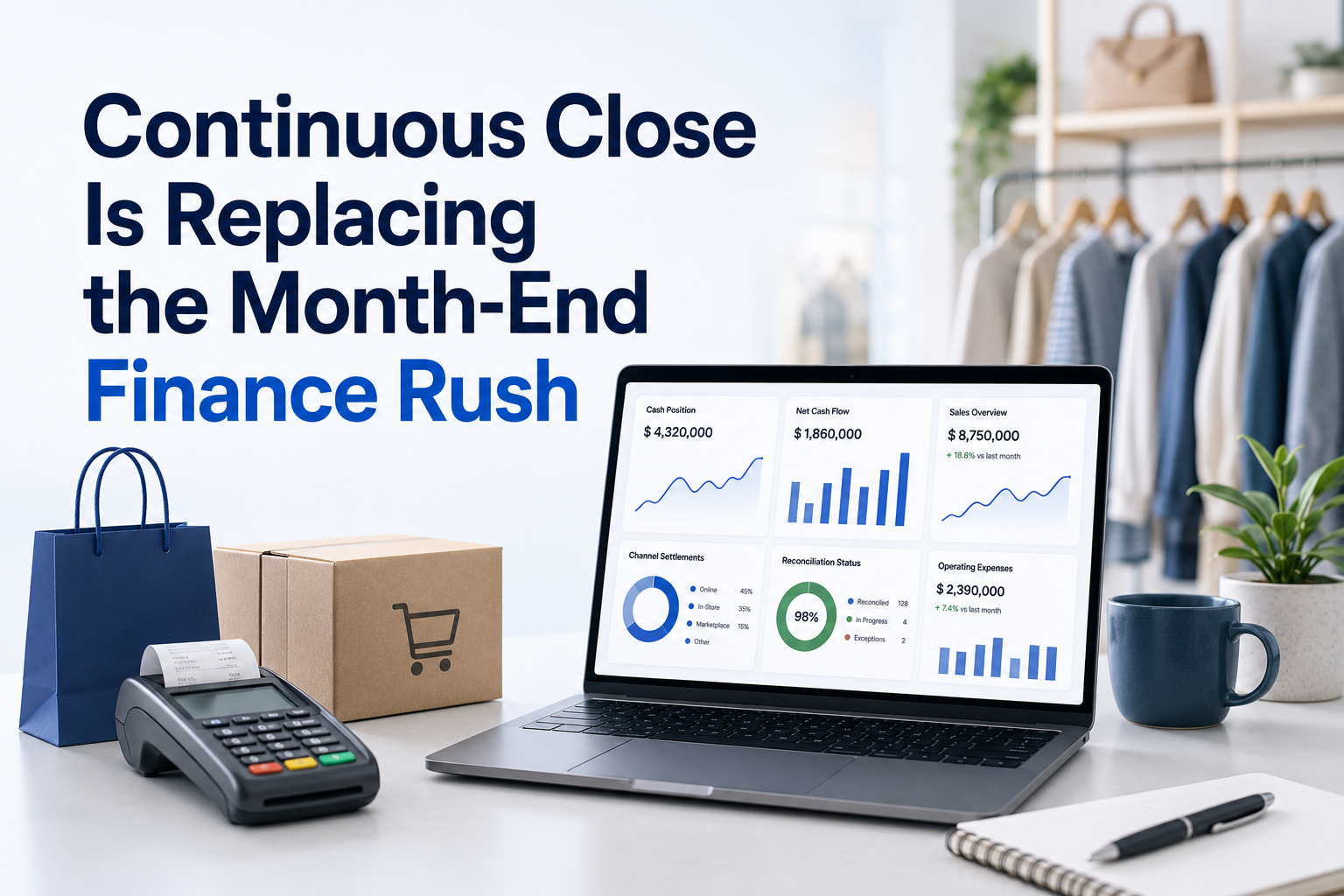
For many finance teams, month end follows a familiar pattern. Routine reporting slows down, spreadsheets multiply, departments receive urgent requests for missing information, and accountants work through long reconciliation lists before leadership can review the final numbers.
This pressure is often treated as a normal part of financial management. However, much of the rush exists because accounting checks, approvals, and corrections are delayed until the reporting period is almost over.
Retail and e-commerce businesses feel this pressure more sharply because financial activity moves across many systems. Online orders, store sales, marketplace settlements, customer refunds, supplier invoices, delivery fees, promotions, inventory adjustments, and payment charges all affect the accounts. When these records do not reach finance in a consistent format, the close becomes a process of rebuilding the month.
Continuous close offers a different operating model. Instead of waiting until period end to perform most reconciliations and reviews, finance teams complete smaller accounting tasks throughout the month. Errors are identified closer to the transaction date, supporting records remain easier to locate, and managers receive a more current view of financial performance.
What Continuous Close Actually Means
Continuous close does not mean producing a complete set of statutory accounts every day. It means moving repeatable closing activities closer to the events that create them.
When an invoice is entered, the system can check whether the required purchase order and approval exist. When a marketplace settlement arrives, finance can compare it with the related orders and fees. When inventory is adjusted, the financial effect can be reviewed before the transaction disappears into a large month-end report.
The traditional model groups these activities near the final days of the month. Continuous close distributes them across the reporting period.
This creates a steady finance rhythm:
- Transactions are checked when they are recorded
- Exceptions are assigned before they become old
- Accounts are reconciled throughout the month
- Missing documents are requested while the activity is still familiar
- Managers review current results instead of waiting for a final reporting pack
The period-end close still exists. However, it becomes a final review of work that has already been maintained rather than an emergency effort to locate and correct an entire month of activity.
Retail Finance Is Especially Difficult to Rebuild Later
A retail transaction may appear simple to the customer, but it can create several financial records behind the scenes. A single order may include product revenue, sales tax, a discount, delivery income, payment processing fees, marketplace commission, inventory cost, and a later refund.
If sales, payments, logistics, inventory, and finance operate through separate systems, those records may update at different times. Finance then needs to determine whether the difference is a timing issue, missing transaction, incorrect fee, partial settlement, or system error.
The task becomes harder when several sales channels are involved. A retailer may operate stores, its own e-commerce site, social commerce, mobile applications, and third-party marketplaces. Each channel may use different settlement periods, fee structures, refund rules, and transaction references.
Waiting until month end means finance teams are investigating issues long after the original activity. Customer service may no longer remember the refund. Operations may have already closed the shipment record. The employee who approved the adjustment may need to search through several systems to explain it.
Continuous review keeps the question close to the event.
Reconciliation Should Become an Exception Process
Traditional reconciliation often requires employees to compare complete files even when most transactions already match. Teams review large settlement reports, payment records, bank activity, invoices, and inventory movements to locate a small number of differences.
Modern finance systems can compare records continuously and send only unmatched items for review. The accountant focuses on exceptions instead of checking every correct transaction manually.
For example, the system can identify:
- A sales order with no matching payment
- A marketplace settlement that does not match the expected amount
- A refund recorded by customer service but not reflected in the payment platform
- A supplier invoice that exceeds the approved purchase order
- An inventory adjustment without a reason or supporting document
- A transaction posted to an unusual account or cost center
The system should not decide that every difference is an error. Timing, partial deliveries, approved discounts, and contractual fees can create valid mismatches. Its role is to present the difference with enough context for finance to review it quickly.
Inventory Accounting Cannot Wait Until Period End
Retail finance depends heavily on accurate inventory records. Stock receipts, transfers, sales, returns, damage, shrinkage, and write-offs all affect the value of inventory and the cost of goods sold.
When operational stock data is corrected only during month-end counts, the financial reports remain uncertain throughout the period. Teams may see strong revenue without understanding that margins have fallen. A stock adjustment may appear as a finance problem even though it began as a warehouse process issue.
Continuous close connects inventory activity with finance earlier. Large adjustments can be reviewed when they occur. Returned products can remain outside available stock until inspection is complete. Damaged items can move through an approved write-off process instead of disappearing through manual changes.
Finance teams gain a more reliable cost view, while operations teams gain clearer responsibility for the transactions affecting financial results.
Approvals Are Part of the Close
Closing delays are often described as accounting problems, even when the finance team is waiting for another department.
An invoice may remain pending because procurement has not confirmed the receipt. An expense may lack documentation. A discount may need approval from a sales manager. A project cost may not have the correct department or budget reference.
These tasks should not remain hidden until finance begins closing the month.
A connected workflow can route each exception to the responsible person as soon as it appears. The request includes the transaction, missing information, due date, and supporting records. Finance can track the response without sending repeated emails.
This changes accountability. The close becomes an organization-wide process rather than a finance deadline that other teams hear about near the end of the month.
Live Reporting Requires Controlled Data
Real-time dashboards are useful only when the underlying records are current and reliable. A report can update instantly while still presenting incorrect results if transactions remain incomplete, duplicated, or wrongly classified.
Continuous close improves live reporting because it combines speed with regular control. Data is reviewed throughout the month instead of being accepted provisionally until period end.
Leadership can then use current reports for decisions about cash flow, purchasing, margins, promotions, staffing, and inventory. The figures may still include valid timing differences, but they are less likely to contain weeks of unresolved accounting work.
This is especially useful in retail, where performance can change quickly. Managers should not need to wait until the following month to learn that a promotion reduced margins, payment fees increased, or one sales channel generated a high volume of returns.
Automation Must Preserve Financial Control
Continuous close depends on automation, but it should not remove review from sensitive financial decisions.
Routine matching, notifications, recurring entries, and document checks can often run automatically. High-value payments, unusual journals, write-offs, policy exceptions, and changes to financial master data still require authorized review.
A controlled process may work as follows:
- The system performs the initial transaction check
- Standard records continue without manual intervention
- Unusual items are routed to the responsible reviewer
- Approvals and changes are recorded in the audit history
- Finance reviews unresolved exceptions before the reporting period ends
This approach reduces repetitive work while preserving accountability. Automation handles volume. Employees manage judgment, risk, and policy.
The Finance Team’s Role Starts to Change
When accountants spend less time collecting files and matching routine transactions, they can give more attention to financial interpretation.
Instead of explaining why the close is delayed, finance can discuss why margins changed. Rather than correcting old coding issues, teams can review current spending. Instead of producing reports after decisions have already been made, finance can provide information while managers still have time to respond.
Continuous close does not reduce the need for finance expertise. It moves that expertise closer to the daily operation.
Accountants still define policies, review exceptions, protect controls, prepare formal reports, and apply professional judgment. The difference is that the system supports those responsibilities throughout the month.
How Synclo Supports Continuous Finance Operations
Synclo connects finance with sales, procurement, supply chain, inventory, workforce data, projects, documents, and approvals. This gives finance teams access to the operational context behind each transaction without moving between unrelated systems.
A supplier invoice can be reviewed against its purchase request, approval, order, and receipt. A retail sale can connect with payment and inventory activity. An expense can carry its department, project, document, and approval history. Exceptions can move through assigned workflows instead of remaining inside personal inboxes.
Managers gain a current view of cash flow, revenue, expenses, inventory value, approvals, and pending finance tasks. Meanwhile, finance teams can focus on incomplete or unusual records before the month-end deadline arrives.
Synclo does not remove the need for closing controls. It makes those controls part of daily financial operations.
Month End Should Confirm the Numbers, Not Discover Them
The month-end rush is often a symptom of disconnected operations. Transactions happen throughout the business, but finance receives the full context only after the period is nearly finished.
Continuous close changes that sequence. Reviews happen earlier, exceptions remain visible, approvals move through structured workflows, and supporting records stay connected to the transactions they explain.
The result is not a close that disappears. It is a close that becomes shorter, more predictable, and easier to manage.
Retail and e-commerce businesses need financial information while sales, stock, and spending are still moving. They cannot manage current operations through reports that become reliable only several weeks later.
The future of finance is not simply faster accounting. It is a connected operating model where financial control happens throughout the business cycle and month end becomes the final confirmation of work already completed.
