








- Static pipeline reports often show opportunity status without revealing whether demand, inventory, pricing, and production conditions still support the sale.
- Revenue intelligence connects customer activity with operational data so sales teams can focus on deals that are both likely to close and practical to fulfil.
- Synclo Sales CRM brings customer relationships, quotations, inventory context, tasks, approvals, and reporting into one connected sales process.
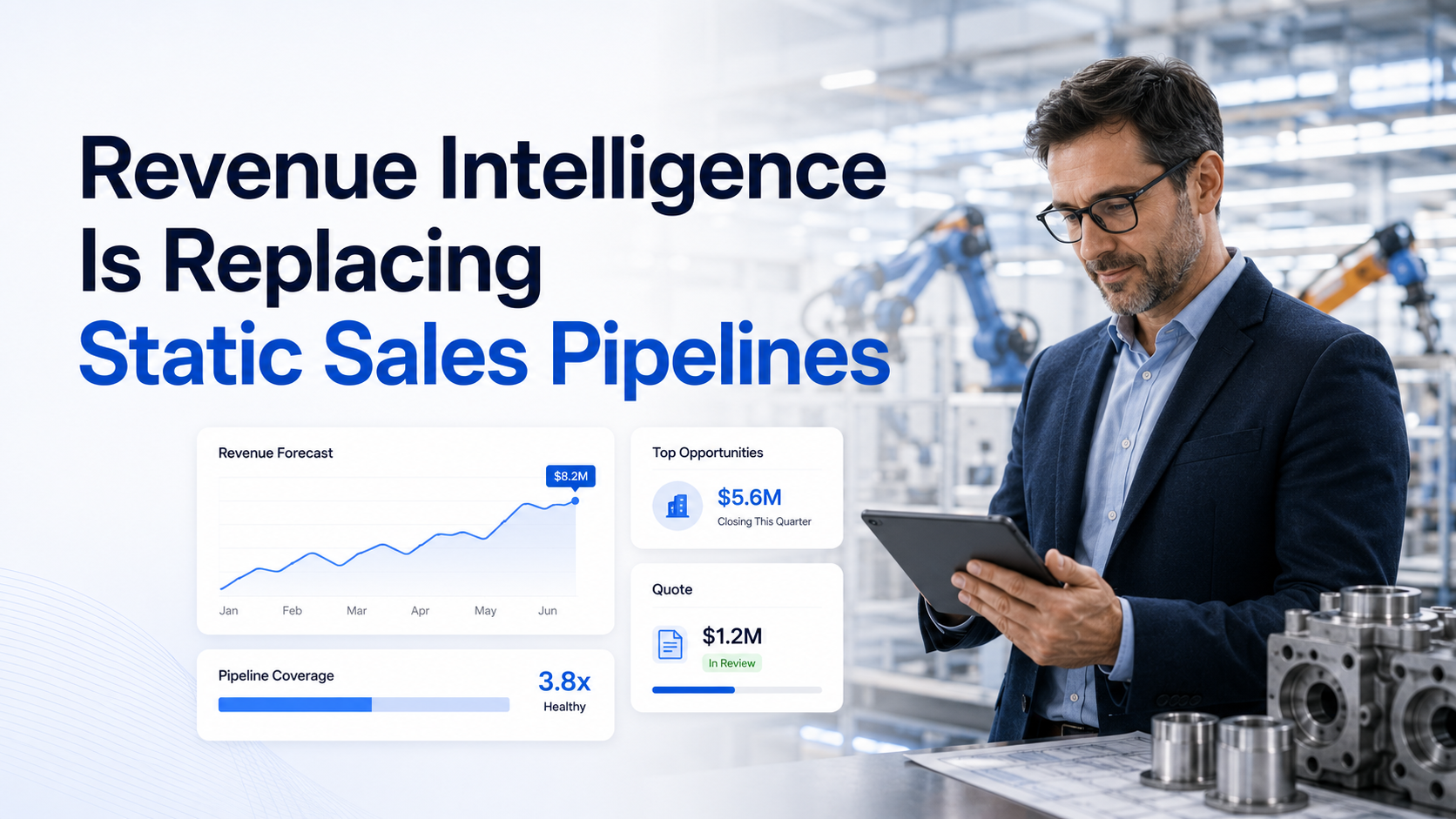
Manufacturing sales teams have traditionally managed opportunities through pipeline stages. A lead becomes qualified, a quotation is prepared, discussions continue, and the opportunity eventually moves toward won or lost.
This structure gives managers a useful overview, but it does not always explain what is happening inside each deal.
Two opportunities may appear in the same stage while carrying completely different levels of risk. One customer may have confirmed specifications, approved the budget, and requested final delivery dates. Another may have stopped responding several weeks earlier but remains listed as active because no one has updated the record.
The pipeline shows where the deal was placed. It does not necessarily show whether the opportunity is moving.
Revenue intelligence adds a more current layer to sales management. It combines customer interactions, quotation activity, product demand, historical patterns, inventory conditions, fulfilment requirements, and salesperson actions to help teams understand which opportunities deserve attention.
The objective is not to replace sales judgment with a score. It is to give sales teams enough context to make that judgment earlier and more consistently.
Static Stages Can Hide Inactive Opportunities
Sales pipelines depend on employees updating opportunity stages correctly. In practice, representatives are often focused on customer discussions, quotations, site visits, product requirements, and internal coordination.
CRM updates may happen later.
An opportunity can remain marked as proposal sent even when the quotation has expired. A lead may stay qualified after several unsuccessful follow-ups. Another deal may appear inactive because the representative has not recorded recent calls or messages.
This weakens pipeline reporting. Managers see the official stage but not the real level of customer engagement.
Revenue intelligence examines the signals around the opportunity, including:
- Recent customer communication
- Response frequency
- Meeting activity
- Quotation changes
- Requested documents
- Sample or demonstration activity
- Decision deadlines
- Time spent without a meaningful next step
These signals help teams identify opportunities that are progressing, slowing down, or becoming inactive.
The representative still determines the correct response. However, the system can make hidden inactivity visible before the opportunity becomes impossible to recover.
Manufacturing Sales Depend on Operational Reality
In many industries, sales teams can manage opportunities largely through customer communication and pricing. Manufacturing sales require a wider operational view.
A customer may be ready to place an order, but the business must still confirm material availability, production capacity, technical requirements, quality expectations, and delivery timing.
A large opportunity is not valuable if the company cannot fulfil it profitably or within the promised schedule.
Sales representatives therefore need access to more than customer records. They need current information about:
- Product availability
- Material lead times
- Production capacity
- Existing order commitments
- Pricing and discount rules
- Delivery requirements
- Technical specifications
- Credit and approval status
When this information is spread across separate systems, representatives depend on repeated internal follow-ups before they can give the customer a reliable answer.
Revenue intelligence becomes stronger when CRM data connects with operational data. The system can show not only which customer may buy, but also whether the business is ready to support the opportunity.
Forecasts Need Evidence Behind the Number
Sales forecasts are often built from opportunity value, stage, expected close date, and salesperson judgment.
These inputs are important, but they can produce overly optimistic forecasts when opportunity stages are outdated or close dates are repeatedly moved forward.
A more useful forecast considers the evidence behind each opportunity.
For example, the system may review whether:
- The customer has confirmed a real requirement
- Decision-makers are involved
- A quotation has been opened or discussed
- Technical questions have been resolved
- Pricing approval is complete
- A next meeting has been scheduled
- The expected delivery period remains realistic
- Similar opportunities have historically closed at this stage
The result should not be treated as a guaranteed prediction. It provides another perspective that managers can compare with the salesperson’s assessment.
When the system and the representative disagree, that difference creates a useful management conversation. The team can review whether the opportunity contains evidence that has not been recorded or whether the forecast needs adjustment.
Customer Intent Appears Across Several Interactions
A customer rarely announces that they are becoming more or less likely to buy. Intent appears through smaller actions.
A prospect may request technical documentation, include additional decision-makers in a meeting, ask about implementation timelines, or seek clarification about payment terms. These actions can indicate movement toward a decision.
Other patterns may indicate risk. The customer stops responding, repeatedly delays meetings, requests large pricing changes without discussing specifications, or avoids confirming the buying process.
Revenue intelligence helps combine these signals into one opportunity view.
This does not mean every email or click should create an alert. Too much activity data creates noise. The system should focus on actions that have a practical relationship with the sales process.
The purpose is to help the representative prepare a more relevant next step rather than send another generic follow-up.
Quotation Activity Should Remain Connected to the Opportunity
Manufacturing quotations often contain product configurations, volumes, delivery schedules, commercial terms, taxes, transport costs, and validity periods.
When quotations are created outside the CRM, the opportunity record may show only that a proposal was sent. Managers cannot easily see which version is current, what changed during negotiation, or whether the approved price still supports the expected margin.
Connected quotation management creates a clearer commercial history.
Teams can review:
- Quotation versions
- Products and quantities
- Approved discounts
- Expected margin
- Expiry dates
- Customer feedback
- Internal approvals
- Final accepted terms
This gives revenue forecasts more operational meaning. A high-value opportunity with an unapproved discount or unrealistic delivery promise should not be treated the same as a deal that has passed commercial and operational review.
Sales Activity Should Lead to a Clear Next Action
CRM systems often collect large amounts of activity without improving execution. Calls, emails, notes, and meetings appear in the record, but the representative still needs to decide what happens next.
Revenue intelligence should convert activity into useful direction.
The system may identify that:
- A quotation is close to expiry
- A decision date has passed
- A technical question remains unanswered
- A customer has not received a promised document
- An opportunity has no scheduled next action
- A high-value deal has been inactive for too long
- Internal pricing approval is blocking customer follow-up
These are not final sales decisions. They are operational exceptions that help representatives protect momentum.
A salesperson should begin the day with a focused list of opportunities requiring attention rather than search manually through the full pipeline.
Managers Need More Than a Weighted Pipeline Total
A weighted pipeline multiplies opportunity value by an estimated probability. The result may provide a broad forecast, but it can hide important differences.
A pipeline may appear healthy because it contains several large opportunities. If those deals have weak engagement, unresolved technical requirements, or unrealistic close dates, the total creates false confidence.
Managers need a layered view that includes:
- Total pipeline value
- Opportunities with strong engagement
- Deals waiting for internal action
- Quotations approaching expiry
- Opportunities without a next step
- Forecast changes since the previous review
- Operational constraints affecting delivery
- Concentration around a small number of customers
This helps leaders distinguish between visible opportunity value and dependable revenue potential.
Sales meetings can then focus on decisions and obstacles rather than asking representatives to repeat information already stored in the CRM.
AI Should Assist the Seller Without Replacing the Relationship
Artificial intelligence can summarize customer histories, identify missing information, recommend follow-ups, and highlight unusual pipeline movement.
It can also reduce administrative work by preparing meeting summaries, updating activity records, and organizing opportunity information.
However, manufacturing sales often involve complex requirements, long relationships, technical discussions, and commercial negotiation. Customers expect representatives to understand their business and respond with informed judgment.
AI should therefore support activities such as:
- Summarizing account and opportunity history
- Identifying inactive or at-risk deals
- Preparing relevant meeting context
- Suggesting questions based on missing information
- Highlighting forecast inconsistencies
- Drafting routine follow-up communication
- Surfacing internal approvals that require attention
The representative remains responsible for the customer relationship, negotiation, and final commercial judgment.
The best use of AI is not to automate every conversation. It is to help the seller enter each conversation better prepared.
How Synclo Sales CRM Supports Revenue Intelligence
Synclo Sales CRM connects leads, accounts, opportunities, activities, quotations, tasks, approvals, communication history, and reporting within one sales environment.
Representatives can maintain a complete view of each customer without relying on separate spreadsheets and personal notes. Managers can review opportunity movement, pending actions, inactive deals, expected revenue, and team performance through current reports.
Because Synclo connects CRM with supply chain, finance, projects, and broader operations, sales teams can work with stronger business context. Product availability, approvals, documentation, and operational requirements can remain connected to the opportunity instead of being managed through disconnected follow-ups.
AI integration can help teams summarize opportunity history, identify missing next steps, surface sales risks, and prepare more relevant action lists. Human sales teams remain responsible for interpreting the information and managing the relationship.
The result is a CRM that supports execution rather than simply recording activity.
Revenue Intelligence Creates a More Honest Pipeline
A sales pipeline should not be a collection of optimistic opportunity values. It should reflect the current state of customer demand and the organization’s ability to convert that demand into profitable delivery.
Revenue intelligence helps businesses move closer to that standard.
It gives sales teams a clearer view of engagement, risk, operational readiness, and next actions. It helps managers challenge weak assumptions before they enter the forecast. It also connects sales expectations with the production, inventory, pricing, and approval conditions required to fulfil the deal.
Static pipelines will remain useful for structure. However, the next stage of sales management depends on understanding what is changing inside each opportunity.
The businesses that improve this visibility will not simply forecast revenue more accurately. They will know where to act before valuable opportunities lose momentum.
