



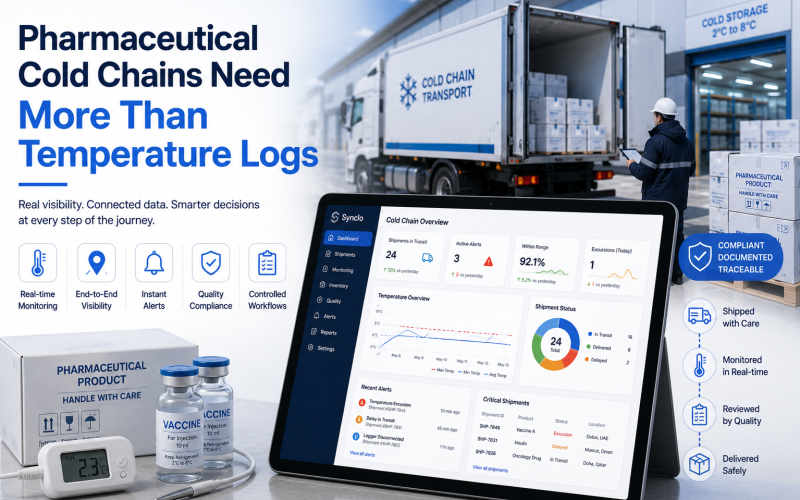
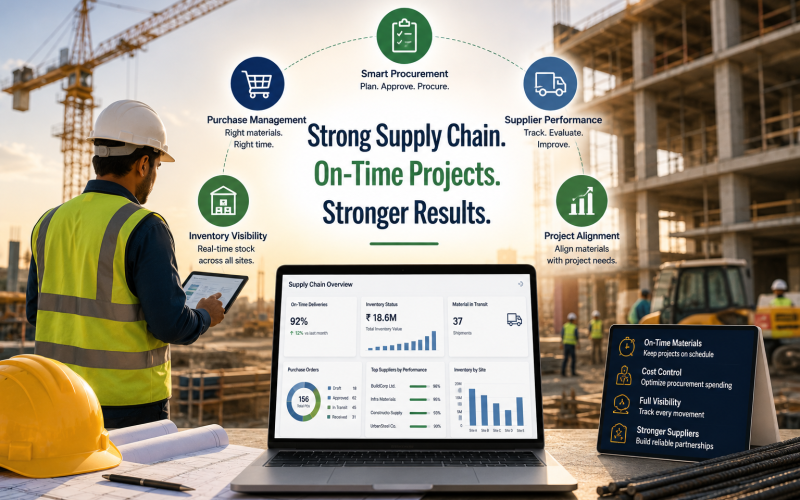

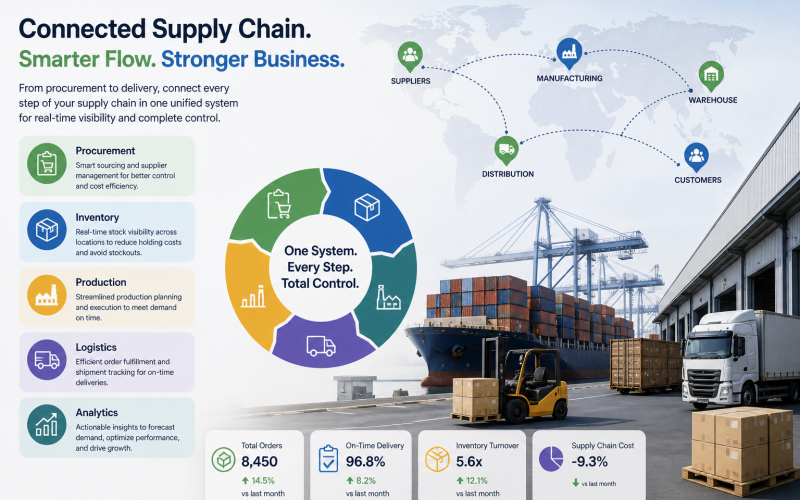

- Supply chain delays often come from internal gaps, not external disruptions
- Lack of real time visibility makes planning and execution unreliable
- Connected systems like Synclo help businesses move goods with more control and less delay
Supply chains are often blamed on external factors such as shipping delays, supplier issues, or changing demand. While those factors matter, many problems begin inside the business. Delays, inefficiencies, and miscommunication often come from how systems and teams are structured.
Most organizations do not operate their supply chain as a single system. Procurement, inventory, logistics, and finance run on separate platforms. Each team works with its own data, which creates gaps in coordination. These gaps slow down decisions and reduce accuracy.
As demand increases, these issues become harder to manage. Small delays build into larger problems that affect production, delivery, and customer satisfaction.
Information Moves Slower Than Operations
In many supply chains, physical movement is faster than data movement. Goods are shipped, inventory changes, and orders are processed, yet the system does not update at the same speed.
Teams rely on reports or manual updates to understand what is happening. By the time information is available, conditions may have already changed. This creates uncertainty in planning and execution.
In practical terms, this leads to:
- Inventory levels that do not match actual stock
- Delays in responding to supply or demand changes
- Decisions based on outdated data
To improve reliability, supply chains need data that updates as operations happen.
Planning Breaks Without Real Time Visibility
Planning depends on accurate information. When data is delayed or incomplete, planning becomes unreliable. Forecasts may look correct on paper but fail during execution.
For example, a business may plan production based on expected inventory, only to discover that stock levels are lower than reported. This forces last minute changes that affect timelines and costs.
A modern supply chain management system needs to provide continuous visibility. Instead of relying on reports, teams should be able to see current conditions at any moment.
Synclo supports this by connecting inventory, procurement, and logistics into one system so updates happen in real time.
Disconnected Systems Create Hidden Delays
Supply chains involve multiple steps, and each step depends on the one before it. When systems are not connected, delays at one stage affect the entire process.
Procurement may not know about changes in demand. Inventory may not reflect recent orders. Logistics may operate without full visibility into stock levels.
This creates hidden delays that are difficult to trace. Teams spend time coordinating instead of executing.
Organizations are moving toward:
- Integrated supply chain platforms
- Centralized business operations systems
- Connected ERP environments
The goal is to remove gaps between systems so that each step flows into the next without delay. Synclo enables this by linking supply chain data across departments, reducing the need for manual coordination.
Inventory Control Depends on Accurate Data
Inventory is one of the most sensitive parts of the supply chain. Too much stock increases costs, while too little disrupts operations. Managing this balance requires accurate and timely data.
When inventory systems are not updated in real time, businesses face constant uncertainty. Stock levels may appear correct but differ from actual availability. This leads to overordering, stockouts, or delayed production.
With a connected inventory management system, updates happen as transactions occur. This improves accuracy and allows teams to make decisions with confidence.
Synclo supports this by integrating inventory data with procurement and operations, ensuring that stock levels reflect actual conditions.
Manual Processes Slow Down Movement
Many supply chain operations still depend on manual steps. Orders are processed by hand, updates are entered manually, and approvals rely on communication outside the system.
This creates delays and increases the risk of error. Tasks cannot move forward until someone takes action.
Automation reduces this dependency. With structured workflows, processes continue without waiting for manual input.
Teams can:
- Track orders as they move through the system
- Update records automatically
- Trigger actions based on changes in data
This improves speed and consistency across operations.
Scaling Supply Chains Requires Structure
As businesses grow, supply chains become more complex. More suppliers, more locations, and more transactions increase the need for coordination.
Without a structured system, this complexity leads to confusion. Processes become harder to manage, and errors increase.
A scalable supply chain system ensures that operations remain consistent as the business expands. It provides a framework for managing workflows, data, and communication across all stages.
Synclo supports this by offering a unified platform that adapts to growth without adding complexity.
What Efficient Supply Chains Look Like
When systems are connected, supply chain operations become more predictable. Data is accurate, processes move without delay, and teams stay aligned without constant communication.
Decisions are made based on current conditions, not past reports. Inventory matches actual demand. Deliveries happen with fewer disruptions.
This does not come from working harder. It comes from removing the gaps that slow everything down.
Supply chains are not limited by movement of goods. They are limited by movement of information. Businesses that fix this are able to operate with more control and respond faster to change.
