





- Healthcare training loses value when employees complete courses that are disconnected from their current role, shift, and responsibilities.
- Learning in the flow of work gives staff short, relevant guidance before a task, policy change, or compliance requirement affects performance.
- Synclo LMS connects roles, skills, assessments, certifications, and training records inside one workforce system.
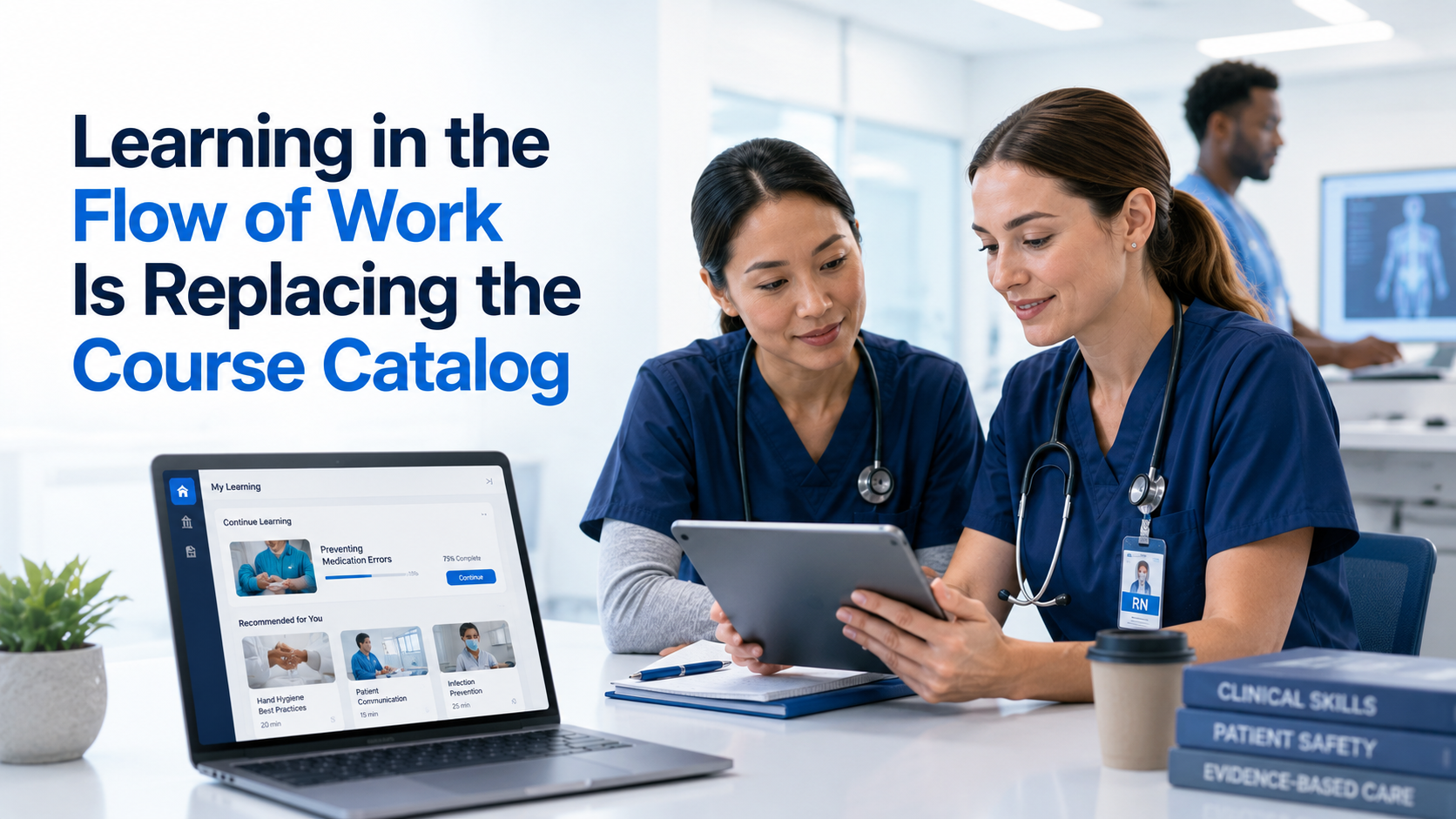
Healthcare organizations do not struggle because they lack training material. Hospitals, clinics, laboratories, pharmacies, and pharmaceutical businesses often maintain large libraries of policies, courses, manuals, presentations, videos, and compliance documents.
The problem is timing.
Employees may complete a course during onboarding and need the information several months later. A policy update may be shared through email, but the employee encounters the related task during a busy shift. A new system may be introduced through one long training session, yet staff still need help when they begin using it in real work.
Traditional learning systems are built around course completion. Employees log in, open assigned material, finish an assessment, and receive a completion record. This approach remains useful for structured programs, but it does not always support the way people learn during daily operations.
Learning in the flow of work takes a different approach. It brings relevant training, guidance, and knowledge closer to the task that requires it. Instead of asking employees to remember everything in advance, the organization gives them access to the right information when the work appears.
The Course Catalog Is Not a Learning Strategy
A large course library can look impressive while remaining difficult for employees to use.
Staff members may not know which course applies to their role. Similar topics may appear under several titles. Older material may remain available after policies change. Employees searching for one procedure may need to open several files before finding a useful answer.
The result is a system that stores learning content without helping people apply it.
A practical learning strategy begins with operational needs rather than the number of courses available. The organization should identify which tasks carry risk, where employees repeatedly ask for help, which skills are changing, and what knowledge must remain current.
The LMS can then organize learning around roles, responsibilities, events, and capability requirements.
A nurse, laboratory technician, pharmacist, finance employee, and maintenance worker should not receive the same learning path simply because they work for the same organization. Each person needs a defined route based on the work they perform.
Healthcare Knowledge Changes While Work Continues
Healthcare employees work inside environments where procedures, equipment, systems, and requirements continue to change. Training cannot pause operations every time an update occurs.
A new documentation rule may affect clinical staff. A revised storage procedure may affect pharmacy and warehouse teams. A cybersecurity warning may require employees to change how they handle messages or patient data. A new device may require technical instruction before it is used.
Organizations often respond by sending an announcement and assigning a course. However, communication and learning are not the same.
An employee may read the message without understanding how the change affects daily work. Another may complete the course but forget the details before applying them. A third may not realize the update is relevant to their role.
Learning in the flow of work connects the update with the point of action. Employees receive guidance before they perform the affected task, while managers can confirm that the required understanding has been assessed.
Short Learning Does Not Mean Shallow Learning
Flow-of-work learning is often associated with short videos, quick guides, checklists, and brief assessments. These formats are useful, but they should not replace detailed training where deeper knowledge is required.
Some subjects need structured instruction. Clinical procedures, safety standards, equipment operation, leadership development, data protection, and regulated processes cannot be reduced to a few slides.
The stronger model combines several learning formats.
A complete program may include:
- A structured course that explains the full subject
- A practical assessment that confirms understanding
- A short guide available during the task
- Refresher training after a defined period
- Manager observation or skills validation
- Updated material when the process changes
The detailed course builds knowledge. The task-level resource helps employees apply it. Together, they provide stronger support than either format alone.
Learning Should Respond to Workforce Events
Traditional LMS assignments often follow an annual calendar. Every employee receives required courses at the same time, regardless of their current responsibilities.
A connected learning system can assign training when workforce events occur.
For example, learning may begin when:
- An employee joins the organization
- A person moves into a new department
- A manager assigns a different responsibility
- A certification approaches expiration
- A new policy becomes effective
- Equipment is introduced at a facility
- An assessment identifies a capability gap
- A quality incident reveals missing knowledge
This makes training more relevant because the assignment has a clear operational reason.
It also reduces unnecessary learning. Employees do not need to complete material that has no connection to their work simply because it exists in the catalog.
Compliance Requires More Than a Completion Record
Healthcare organizations need evidence that required training has been assigned and completed. However, a completion status does not always prove that the employee understands the subject or can apply it correctly.
An employee may click through a course quickly, repeat an assessment until they pass, or complete training long before the related responsibility begins.
A stronger compliance record connects several forms of evidence:
- Course completion
- Assessment results
- Attempts and completion dates
- Practical validation
- Manager confirmation
- Certification status
- Refresher requirements
- Version of the policy or procedure studied
This distinction matters when a policy changes. The organization needs to know which employees completed the current version, not only whether they completed a course with a similar title in the past.
Learning records should therefore show the content version, effective date, and role requirement connected to each assignment.
Managers Need a Capability View
Most LMS dashboards focus on enrollment, completion, and overdue courses. These measures help administrators manage assignments, but managers need a clearer view of workforce readiness.
A department manager should be able to see whether the team has the required knowledge and certifications for upcoming work. A supervisor may need to know who can operate a device, perform a procedure, support an audit, or cover a specialist responsibility.
This requires learning data to connect with skills and roles.
A useful capability view can show:
- Required skills for each position
- Verified capability by employee
- Training currently in progress
- Certifications approaching expiration
- Assessment areas where the team is struggling
- Employees who are ready for additional responsibility
- Gaps that may affect staffing or service delivery
The LMS then becomes part of workforce planning instead of a separate administrative portal.
Search Must Be Designed Around the Employee’s Problem
Employees rarely search a learning platform using the formal name of a course. They search for the problem in front of them.
A staff member may search for how to record a specific incident, prepare equipment, handle a damaged package, or complete a new approval process. If the system requires knowledge of the course title or department folder, the employee may give up and ask a colleague.
Learning content should use the language employees use during work.
Search results should also distinguish between different types of material. A policy, quick guide, full course, checklist, and frequently asked question serve different purposes.
The employee should be able to identify which item provides an immediate answer and which one requires detailed study.
AI Can Help Employees Find Knowledge Faster
AI can make learning content easier to access by helping employees search in natural language, summarize approved material, and locate relevant guidance.
However, healthcare organizations should control which sources the AI can use. A general response created from unknown internet content should not replace an approved internal policy or procedure.
A governed learning assistant should work from authorized content and respect access permissions. It should also direct employees to the original source when the subject requires formal confirmation.
AI can support activities such as:
- Finding the correct course or policy
- Summarizing approved training material
- Recommending learning based on a role
- Identifying content related to a skills gap
- Generating practice questions from approved material
- Reminding employees about pending or expiring requirements
The system should help employees reach trusted knowledge faster, not create a second uncontrolled source of instructions.
Content Ownership Must Remain Clear
Learning material becomes unreliable when no one owns its accuracy.
A course may remain active even after the related process changes. Different departments may publish conflicting instructions. Employees then choose whichever document appears first or ask an experienced colleague for clarification.
Every important learning item should have a named owner, review date, approval status, and version history.
Content governance should define:
- Who creates the material
- Who confirms technical accuracy
- Who approves publication
- When the content must be reviewed
- What happens when a policy changes
- How outdated versions are removed
- Which employees must complete the update
This work may appear administrative, but it protects the organization from employees acting on expired guidance.
How Synclo LMS Supports Learning During Work
Synclo LMS connects training with employee records, roles, departments, performance, certifications, documents, and workforce workflows.
Organizations can create role-based learning paths, assign courses after workforce events, manage assessments, and track certification requirements. Managers can review progress and capability without requesting separate reports from the learning team.
Employees can access courses, short guides, policies, and knowledge resources through one connected environment. Training can also be linked to new responsibilities, policy changes, performance goals, and required skills.
Because Synclo connects LMS and HRMS data, learning assignments can reflect the employee’s actual position and career stage. A newly promoted supervisor can receive management training. A pharmacy employee can receive updated storage guidance. A technician can be assigned device training before working with new equipment.
The result is a learning system connected to operational need rather than a general course list.
Learning Becomes Useful When It Arrives at the Right Time
A course catalog remains valuable, but it should not define the full learning experience.
Healthcare employees need structured programs for complex subjects, short guidance during daily work, and clear updates when responsibilities change. Managers need to know whether the workforce is ready, not only whether courses are complete.
Learning in the flow of work closes the distance between training and performance. It gives employees access to trusted information when they are most likely to use it.
The future of healthcare learning is not a larger library. It is a connected system that understands who the employee is, what work they perform, which capability they need, and when the learning becomes relevant.
