





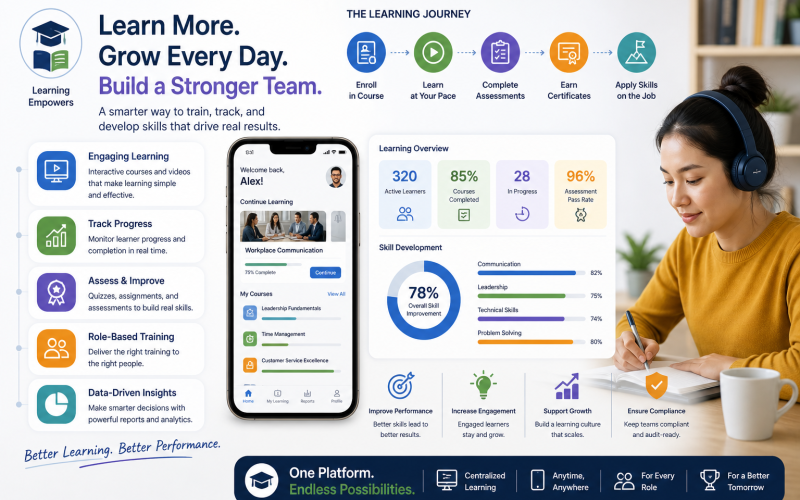


- Technology companies build training debt when employee knowledge fails to keep pace with new tools, products, and processes.
- One-time onboarding cannot prepare teams for continuous software updates, security risks, and changing client requirements.
- A connected LMS helps businesses turn employee learning into an ongoing operational process instead of an occasional HR activity
Technology companies often invest heavily in product development, infrastructure, cybersecurity, and new software tools. However, employee development does not always receive the same attention. Teams are expected to learn new platforms, understand product changes, follow revised processes, and handle new client requirements while continuing to meet daily deadlines.
Over time, the gap between what employees know and what their roles require begins to grow. This gap can be described as training debt.
Training debt works much like technical debt. A business delays necessary learning because current work appears more urgent. Employees find temporary solutions, depend on a few experienced colleagues, or learn through trial and error. The organization continues operating, but the cost of missing knowledge increases quietly in the background.
Eventually, the business starts to experience repeated mistakes, slow onboarding, inconsistent service, security concerns, and delivery delays. The problem may appear to be poor performance, but the real cause is often that employees have not received the training required to keep pace with the business.
What Is Training Debt?
Training debt is the accumulated cost of delayed, incomplete, or outdated employee learning. It develops when roles change faster than training programs, when experienced employees hold undocumented knowledge, or when organizations introduce new systems without preparing the people expected to use them.
In a technology company, this can happen quickly. A development framework changes, a new security standard is introduced, a product feature is released, or a support process is updated. Employees may receive a short email or attend one meeting, but they are still expected to apply the change correctly during daily work.
At first, the impact may seem limited. A few people ask for help, some tasks take longer, and small errors appear. However, when the business continues adding new requirements without closing earlier learning gaps, training debt compounds.
Common signs include:
- Employees repeatedly asking the same operational questions
- New hires taking too long to work independently
- Work quality changing significantly between teams
- Senior employees spending too much time explaining routine tasks
- Product or process updates being applied inconsistently
- Training records showing completion without clear improvement in performance
Training debt is not always caused by a lack of effort. In many cases, businesses provide training, but the content is difficult to access, unrelated to current work, or delivered too late to be useful.
Why Technology Companies Accumulate Training Debt Faster
Technology teams operate in an environment where change is constant. Software releases, security requirements, customer expectations, internal processes, and development methods rarely remain unchanged for long. As a result, employee knowledge can become outdated even when a person has performed the same role for several years.
In addition, technology companies often grow by promoting experienced employees into management roles. A strong developer may become a team lead, or a skilled support agent may begin managing customer operations. Technical experience can support the transition, but management, communication, planning, and performance responsibilities require a different set of skills.
Without structured learning, employees are expected to develop these abilities while doing the job. Some succeed, but others struggle because they have never been shown what good performance looks like in the new role.
Remote and hybrid work can make the problem harder to detect. In an office, employees may learn through observation and informal conversations. Distributed teams have fewer opportunities for this type of learning, so missing knowledge can remain hidden until it affects a project or customer.
Onboarding Cannot Carry the Entire Learning Strategy
Many companies treat onboarding as the main employee training program. New hires complete introductory courses, receive company documents, and attend sessions about tools and policies. Once onboarding is finished, structured learning becomes less frequent.
This approach assumes the role will remain mostly stable. In technology, that assumption rarely holds.
An employee who joined six months ago may already be working with new features, updated workflows, and different customer requirements. A developer may need to understand a new deployment process. A project manager may need to use a revised reporting method. A support representative may need to explain a product capability that did not exist during onboarding.
Therefore, onboarding should establish a foundation, not act as the final stage of development. Businesses need learning paths that continue throughout the employee lifecycle and respond to changing responsibilities.
Training Debt Affects More Than Employee Performance
The effect of outdated knowledge spreads across the organization. When employees do not understand new processes, managers spend more time reviewing work and correcting avoidable errors. Projects move more slowly because teams need repeated clarification. Customers receive inconsistent answers because staff members have different levels of product knowledge.
Security risk also increases. Technology companies depend on employees following access controls, data handling procedures, and incident response rules. A policy document stored in a shared folder does not guarantee that employees understand how to apply it. Regular training and assessment are needed to confirm that important requirements remain understood.
Training debt can also affect retention. Skilled employees want opportunities to develop. When learning is unstructured, employees may feel that career progress depends on solving everything alone. High performers may leave for organizations that provide clearer development paths, while others remain uncertain about what they need to improve.
Learning Needs to Move Closer to Daily Work
Traditional training often removes employees from their work for long sessions and expects them to remember the information later. A more practical approach connects learning to the tasks employees are currently performing.
For example, a support agent learning about a new product feature should receive training before customer questions begin. A developer moving into a lead role should receive management training during the transition, not several months afterward. A finance employee using a new approval workflow should be able to access a short guide when the task appears.
This does not mean every course must be brief. Some subjects require detailed instruction and assessment. However, the learning system should make the right information easy to find when employees need it.
A practical continuous learning model may include:
- Role-based learning paths for each department
- Short courses tied to product or process updates
- Assessments that confirm understanding
- Refresher training for security and compliance
- Development plans for employees moving into new roles
- A searchable knowledge base for task-specific guidance
The aim is to make learning part of operational activity rather than a separate event that employees complete once a year.
Managers Need Visibility Into Capability, Not Just Course Completion
Completion rates are useful, but they do not provide a complete view of workforce readiness. An employee may finish a course quickly without understanding the material. Another employee may understand the content but still need support applying it during work.
Managers need clearer information about skill development. They should be able to see which employees completed required training, how they performed in assessments, which skills remain incomplete, and where multiple team members are struggling with the same topic.
This information helps businesses identify training needs before they affect delivery. If several support employees perform poorly on a product assessment, the company can provide additional learning before customers receive incorrect information. If new project managers repeatedly struggle with resource planning, leadership can create a focused development program.
Learning data becomes more useful when it is connected to roles, departments, performance goals, and business requirements.
How Synclo Helps Reduce Training Debt
Synclo brings learning management into the same operational environment used for workforce management, performance, projects, communication, and reporting. This helps businesses connect employee development with actual organizational needs.
Through Synclo LMS, companies can create courses, assign role-based learning paths, track progress, manage assessments, and maintain training records. Managers gain visibility into completed and pending learning, while employees can access development material through one system.
Because the LMS is connected with broader workforce data, businesses can assign training based on department, role, responsibility, or career stage. A newly promoted manager can receive a leadership path. A product team can receive training before a release. Employees with expiring certifications can be reminded before compliance gaps appear.
The system also helps reduce dependence on informal knowledge transfer. Important processes can be documented and converted into structured learning material instead of remaining with a small group of experienced employees.
Training Must Become an Operating Discipline
Technology companies cannot prevent tools, products, and responsibilities from changing. However, they can control how quickly employee knowledge responds to those changes.
Training debt grows when development is repeatedly postponed in favor of immediate delivery. The decision may save time today, but it creates more review, correction, and support work later. Eventually, employees spend more time working around knowledge gaps than the company would have spent closing them properly.
A strong learning system does not require employees to spend every week in long training sessions. It provides clear learning paths, current content, practical assessments, and information that employees can access during real work.
Technology businesses that treat learning as an ongoing operational process can onboard people faster, reduce repeated mistakes, prepare employees for changing roles, and protect important knowledge as the company grows. The goal is not to create more training. It is to deliver the right learning before missing knowledge becomes a business problem.
