






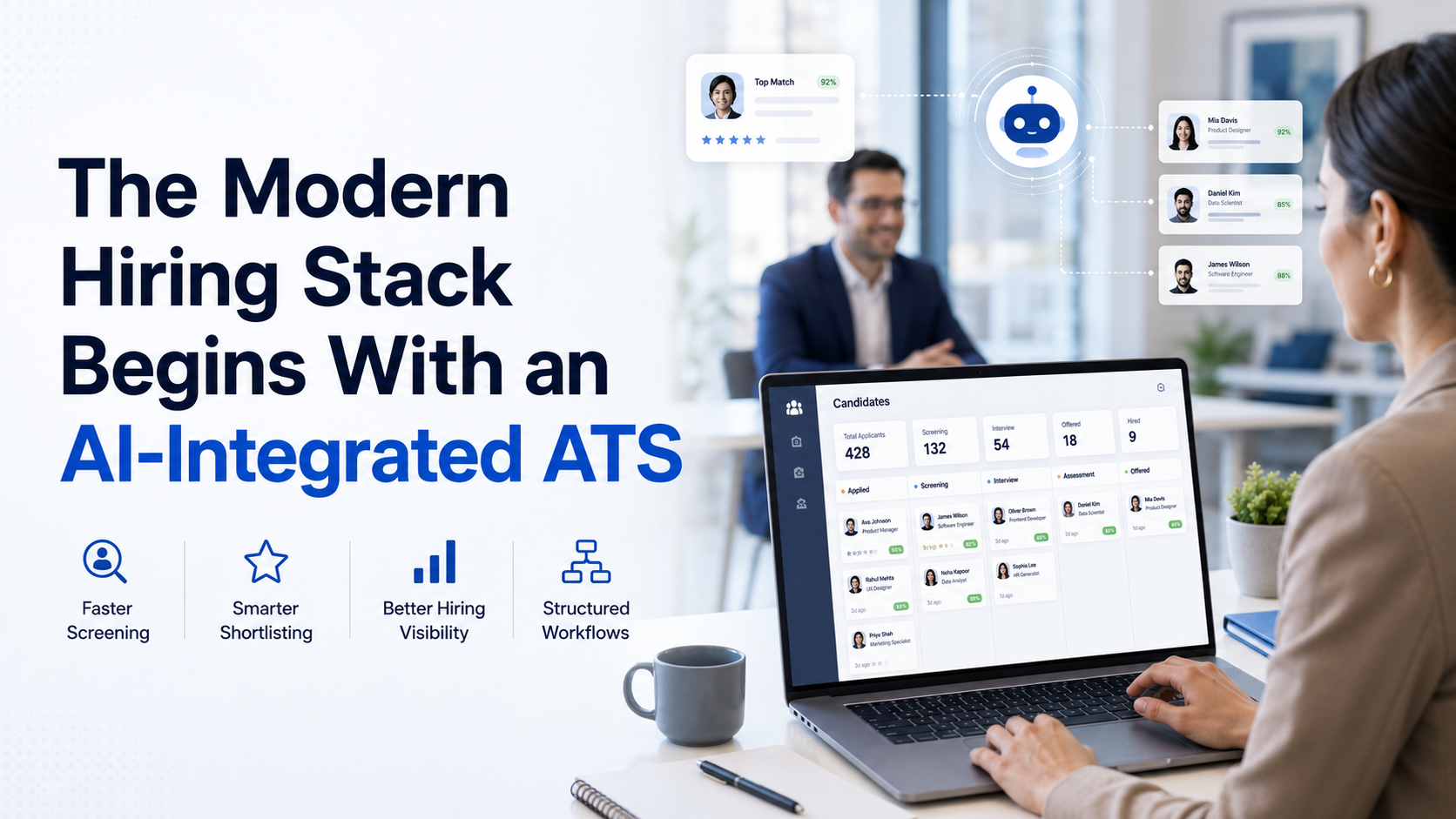
- An ATS creates one structured hiring process for applications, screening, interviews, feedback, approvals, offers, and reporting.
- AI integration helps recruitment teams process growing applicant volumes, surface relevant evidence, and reduce repetitive coordination.
- Synclo HireHub combines intelligent automation with human oversight so companies can hire faster without losing control of decision quality.
Recruitment has become easier to start and harder to manage. Companies can publish vacancies across career pages, job boards, social platforms, and professional networks within minutes. Candidates can discover opportunities faster, tailor applications with AI, and apply to multiple positions with far less effort than before.
This wider access is valuable, but it also creates operational pressure. A single vacancy may generate hundreds of applications, each containing résumés, screening answers, portfolios, documents, and communication history. Recruiters must identify relevant candidates while coordinating hiring managers, interviews, assessments, approvals, and offers.
Without a structured system, the hiring process spreads across email inboxes, spreadsheets, calendars, messaging applications, and personal notes. Candidate information becomes fragmented, feedback arrives late, and managers lose visibility into which roles are moving and which are stalled.
An Applicant Tracking System creates the operational foundation needed to manage this complexity. An AI-integrated ATS goes further by helping teams organize information, identify relevant evidence, automate routine work, and focus human attention where judgment matters most.
An ATS Is the Operating System for Recruitment
An Applicant Tracking System is sometimes described as a database for résumés. That definition understates its role.
A modern ATS manages the complete movement of candidates through the recruitment process. It connects vacancies, applications, screening, interviews, feedback, approvals, offers, and hiring reports in one environment.
When a candidate applies, the system creates a central record. Recruiters can see the role, source, application details, current stage, communication history, interview feedback, and next action without searching across different tools.
This gives every hiring participant a shared view of the process.
A hiring manager can review shortlisted candidates without requesting another spreadsheet. A recruiter can identify overdue feedback without checking several email threads. Leadership can see which vacancies are delayed and where candidates are leaving the process.
The ATS does not simply store information. It creates structure around how hiring work moves.
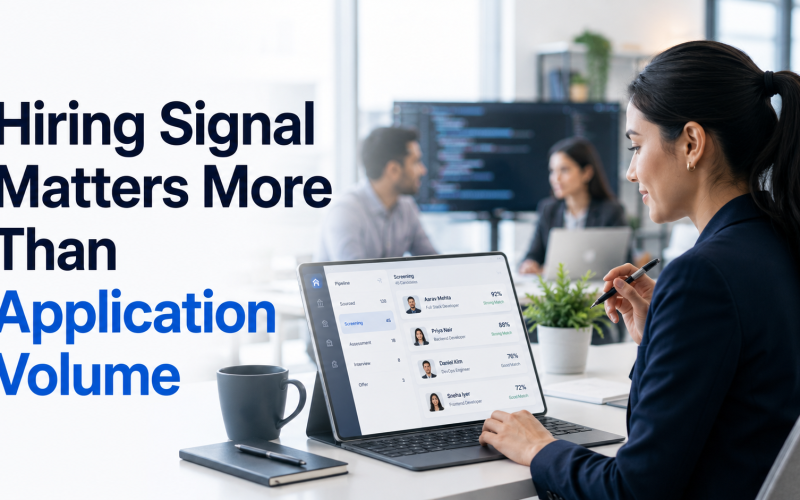
Application Volume No Longer Represents Recruitment Success
Companies once viewed a high number of applications as evidence that a job campaign was performing well. Today, application volume can create a misleading picture.
Digital job platforms allow candidates to apply quickly, while generative AI can help them rewrite résumés and cover letters for individual roles. This means a vacancy may attract more polished applications without producing more qualified candidates.
Recruiters face several challenges at once:
- More applications to review
- Greater similarity between candidate documents
- More keyword-optimized résumés
- Less certainty about practical capability
- Increased pressure to respond quickly
The purpose of an ATS should not be to reject applicants as quickly as possible. It should help recruiters separate relevant signals from application noise.
This requires more than keyword matching. Companies need structured requirements, screening questions, assessments, work samples, interview evidence, and consistent evaluation criteria.
An AI-integrated ATS can organize this evidence so recruiters spend less time processing documents and more time evaluating whether a candidate can perform the work.
AI Can Make Screening More Contextual
Traditional screening often begins with manual résumé review. Recruiters compare experience, qualifications, job titles, and keywords against the vacancy requirements.
This process takes time and can become inconsistent when application volume increases. Different recruiters may interpret the same requirement differently, while strong candidates can be overlooked because they use unfamiliar terminology.
AI can support the first review by extracting structured information from applications and comparing it with clearly defined role criteria.
For example, the system may identify:
- Relevant skills and tools
- Required certifications
- Years and type of experience
- Industry or project exposure
- Screening-answer quality
- Missing mandatory information
- Potential transferable skills
The recruiter can then review a more organized candidate profile instead of interpreting every document from the beginning.
However, AI should support the decision rather than make an unexplained final judgment. Career changes, international experience, nontraditional education, and transferable skills may require human context that automated scoring cannot fully understand.
The strongest model combines AI processing with recruiter review.
Better Hiring Begins With Better Job Requirements
AI cannot improve a hiring process built around an unclear job description.
Many vacancies contain long lists of skills, responsibilities, personality traits, and preferred qualifications without explaining which requirements are truly essential. The screening system then attempts to match candidates against criteria that the company itself has not prioritized.
Before using automation, recruitment teams should define:
- The outcomes expected from the role
- The skills required on the first day
- The capabilities that can be developed after hiring
- The experience that is genuinely necessary
- The evidence that can demonstrate each requirement
- The people responsible for evaluating each area
This creates a clearer evaluation model for both AI and human reviewers.
Instead of searching for someone who appears to match every line of the job description, the company can identify candidates who meet the critical requirements and show potential in the areas that can be learned.
An ATS keeps these criteria connected to the vacancy and applies them consistently throughout screening and interviews.
Automation Removes Recruitment Administration
Recruitment teams spend significant time on work that does not require specialist judgment. They schedule interviews, send reminders, request feedback, update candidate stages, prepare approval messages, and follow up with managers.
These activities are necessary, but they reduce the time available for sourcing, candidate conversations, workforce planning, and selection quality.
An AI-integrated ATS can automate or assist with:
- Application acknowledgements
- Candidate categorization
- Screening-question review
- Interview scheduling
- Reminder notifications
- Feedback requests
- Stage progression
- Candidate status updates
- Offer approval routing
- Recruitment summaries
Automation also reduces inconsistency. Every candidate can receive timely communication, while managers receive the same structured feedback requests after interviews.
The objective is not to remove recruiters from the process. It is to remove repeated coordination that prevents them from doing higher-value recruitment work.
Structured Interviews Become Easier to Manage
Interview quality often varies because different interviewers focus on different subjects. One manager asks technical questions, another discusses career history, and a third relies heavily on personal impressions.
The final hiring decision then depends on feedback that cannot be compared fairly.
An ATS can support structured interviews by connecting each stage with defined competencies, questions, scorecards, and evidence requirements.
For example, a technology role may be evaluated across:
- Technical problem-solving
- Communication
- Security awareness
- Collaboration
- Prioritization
- Learning ability
Interviewers can still ask follow-up questions, but every candidate is reviewed against the same core areas. Feedback remains attached to the candidate record and can be completed before panel discussion begins.
AI can help summarize interview notes and highlight areas where reviewers disagree. The hiring team remains responsible for interpreting the evidence and making the final decision.
Candidate Experience Improves When the Process Is Visible
Candidates judge an employer throughout the hiring process. Long periods without updates, repeated requests for information, confusing interview stages, and last-minute scheduling changes can damage trust before employment begins.
An ATS helps companies create a more predictable candidate journey.
Applicants can receive confirmation when an application is submitted. Interview details can be delivered automatically. Recruiters can see which candidates have waited too long for an update. Communication history remains visible even when another team member takes over the vacancy.
This creates a more professional experience without requiring recruiters to write every message manually.
AI can also help prepare clear, role-specific communication. However, sensitive messages such as rejection feedback, negotiation, and final-offer discussions should still receive human review.
Automation should increase consistency without making the candidate feel that the entire relationship is being managed by a machine.
Hiring Managers Gain Real Accountability
Recruitment delays are not always caused by the recruitment team. A shortlisted candidate may wait because a manager has not reviewed the profile. Interview feedback may remain incomplete. An offer may be delayed by several approval levels.
Without an ATS, these bottlenecks are difficult to separate from general hiring activity.
A connected system shows:
- Candidates awaiting manager review
- Interviews waiting to be scheduled
- Feedback that has not been submitted
- Offers pending approval
- Vacancies with no recent activity
- Candidates at risk of dropping out
Recruiters can address the actual delay instead of chasing every participant equally. Leadership also gains a clearer view of how recruitment responsibility is shared across the organization.
This changes hiring from an HR-owned administrative process into a controlled business workflow.
Recruitment Data Becomes Useful for Planning
An ATS creates data across every stage of hiring. Companies can understand which sources produce qualified candidates, which roles take the longest to fill, where applicants leave the process, and how long managers take to make decisions.
Useful recruitment measures may include:
- Time to first response
- Time to shortlist
- Interview-to-offer ratio
- Offer acceptance rate
- Candidate source quality
- Stage conversion rates
- Hiring-manager response time
- Reasons candidates withdraw
- Reasons offers are declined
AI can help identify patterns inside this data. It may show that one stage creates unnecessary candidate loss, that a particular source produces high application volume but low qualification, or that certain roles repeatedly stall at the same approval point.
These insights help companies improve the process rather than simply complete more hiring activity.
AI-Integrated ATS Platforms Still Need Governance
Recruitment involves sensitive personal data and decisions that affect people’s careers. AI should therefore operate inside clear rules.
Companies need to define:
- Which candidate data AI may access
- Which tasks can be automated
- Which recommendations require human review
- How candidates are evaluated consistently
- How potential errors or bias are reported
- How decisions and changes are recorded
- Who remains accountable for final outcomes
Recruiters should be able to understand why a candidate was highlighted or flagged. Candidates should not be rejected solely through an opaque score that no one can explain.
Human review is not a weakness in AI recruitment. It is part of responsible system design.
How Synclo HireHub Supports Modern Hiring
Synclo HireHub brings vacancies, applicants, screening, interviews, feedback, approvals, offers, and reporting into one connected recruitment system.
Recruiters can manage the complete candidate journey without relying on separate spreadsheets and disconnected communication channels. Hiring managers receive structured candidate information and can provide feedback inside the same workflow.
AI integration helps teams process applications, identify relevant candidate evidence, summarize recruitment activity, and surface the applicants who require closer review. Routine communication, reminders, stage updates, and coordination can move automatically while recruiters maintain control of important decisions.
HireHub also connects with Synclo’s wider workforce environment. Once a candidate is hired, approved information can move into onboarding and HR operations without rebuilding the employee record from the beginning.
This creates continuity between recruitment and employment.
The Modern ATS Strengthens Human Hiring Decisions
Companies need an ATS because recruitment has become too interconnected to manage through isolated tools. Applications, assessments, conversations, feedback, approvals, and decisions must remain part of one traceable process.
AI makes the ATS more useful by reducing administrative work and helping recruiters review larger amounts of information. However, the real value comes from combining automation with structured human judgment.
The ideal AI-integrated ATS does not choose people for the company. It helps the company understand candidates more clearly, respond more consistently, and make better-supported hiring decisions.
Synclo HireHub provides that foundation by connecting recruitment data, workflows, intelligence, and human oversight in one platform.
As hiring becomes faster and application volumes continue to grow, the advantage will not belong to the company that processes the most résumés. It will belong to the company that identifies the right evidence, protects candidate experience, and moves strong talent through the process before competitors do.
