


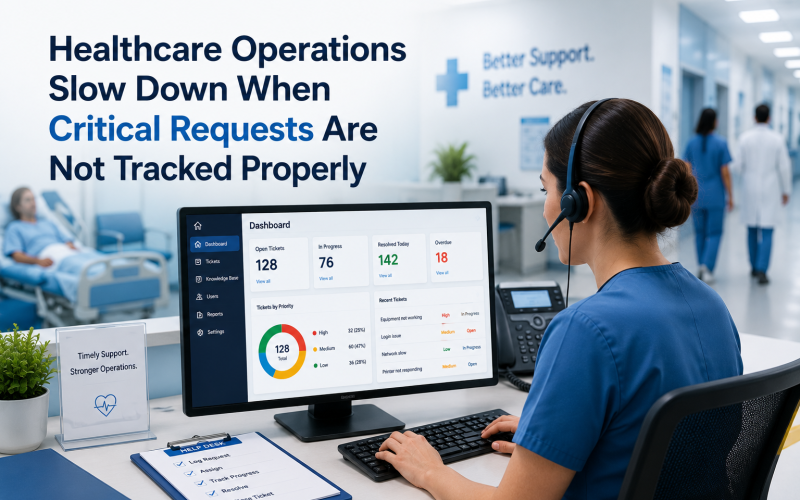


- Hotel service delays often begin in hidden queues spread across calls, messages, notebooks, and department chats.
- Structured request management gives every issue clear ownership, priority, status, and response expectations.
- Synclo helps hospitality teams connect guest requests, internal support, maintenance, and service reporting in one system.
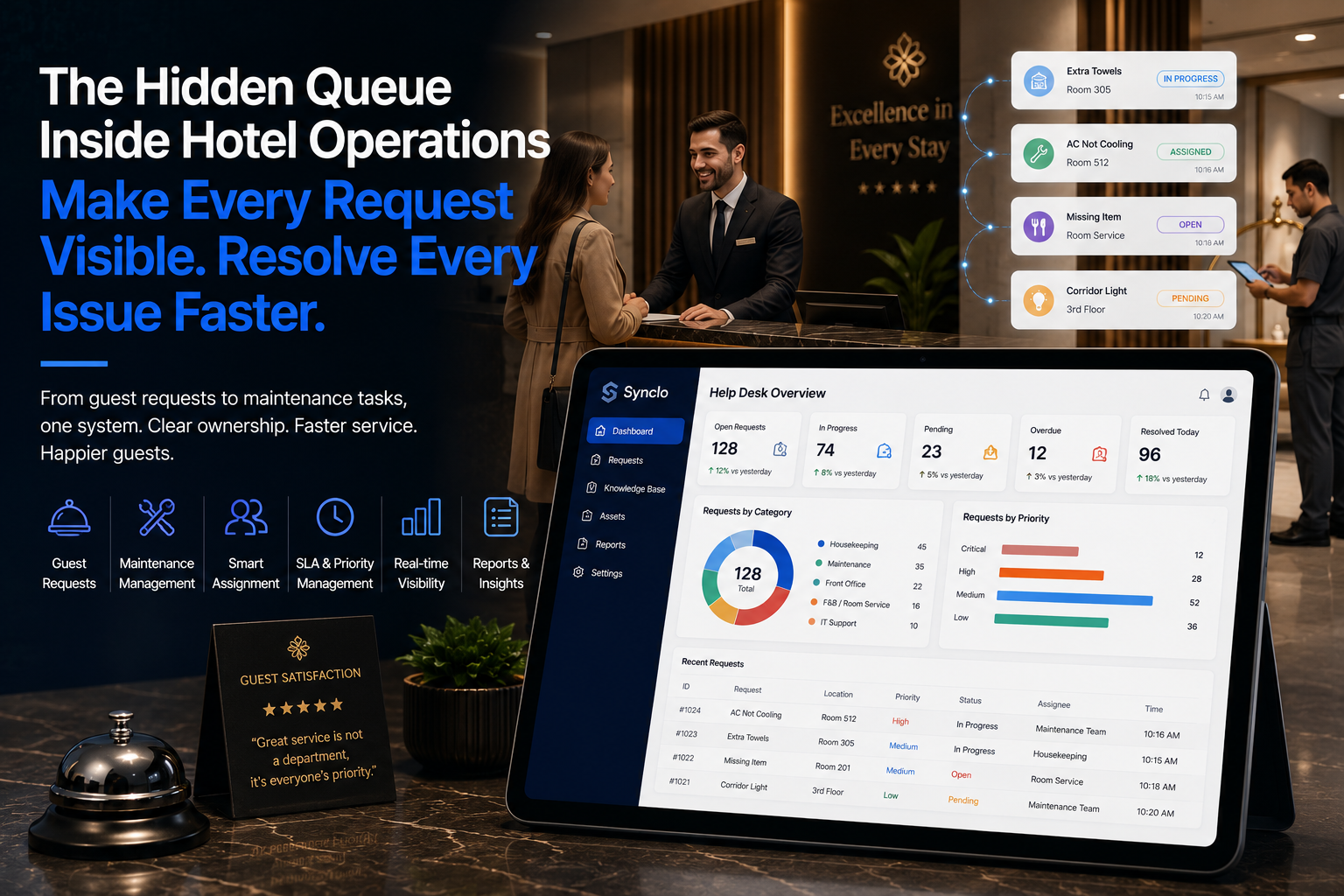
A guest requests fresh towels at reception. The front desk sends a message to housekeeping. A maintenance issue is reported through a staff group chat. Room service receives a phone call about a missing item. An employee tells a supervisor that a corridor light is not working.
Every request appears small. Together, they create a hidden queue of work moving through the hotel without one clear system.
Most hospitality businesses do not fail because employees ignore guests. Problems occur because requests are passed between people through calls, notes, messages, and verbal updates. Staff members may know that something needs attention, but ownership is unclear, progress is difficult to check, and managers cannot see which issues are waiting too long.
The guest experiences only the delay. Behind the scenes, the real problem is often an invisible service queue.
Guest Requests Become Operational Work
A guest request begins as a customer interaction, but it quickly becomes an internal workflow.
A request for an extra bed may involve reception, housekeeping, inventory, and billing. A complaint about air conditioning may require front desk staff, maintenance, room operations, and possibly a room change. A late checkout request may affect housekeeping schedules and the next reservation.
When requests are handled informally, each department sees only its part of the situation. The front desk may believe maintenance is working on the issue. Maintenance may be waiting for room access. Housekeeping may not know that the guest has been moved.
A request management system creates one record that follows the issue from submission to completion. The record should explain what the guest needs, where the issue is located, who owns the next action, and when the response is expected.
This turns a conversation into accountable work.
The Hidden Queue Exists Across Every Department
Hotels often think of service requests as a front desk responsibility. In practice, the queue extends across the full property.
Housekeeping manages room cleaning issues, linen requests, amenities, and lost property. Maintenance handles equipment, plumbing, electrical problems, climate control, and facility repairs. IT supports access systems, payment terminals, networks, and staff devices. Food and beverage teams respond to order issues, allergies, missing items, and event requirements.
Human resources, finance, procurement, security, and administration also receive internal requests that affect daily service.
When every team uses a different method, managers cannot see the complete workload. One department may appear quiet because its requests exist inside personal messages rather than a shared system. Another team may receive duplicate reports because employees cannot check whether an issue has already been submitted.
The queue remains hidden, but the operational pressure continues to grow.
First Response Is Not the Same as Resolution
Hospitality teams often respond quickly to acknowledge a guest, yet the actual request may remain incomplete.
A front desk employee may say that maintenance has been informed. This reassures the guest temporarily, but it does not confirm that a technician accepted the task, reached the room, completed the repair, or reported the outcome.
This gap creates repeated follow-up calls. Guests contact reception again, staff members search for updates, and supervisors interrupt departments to confirm progress.
A structured workflow separates acknowledgment from resolution.
The system can record:
- When the request was received
- When it was assigned
- When the responsible employee accepted it
- Whether work has started
- Whether more information is needed
- When the issue was completed
- Whether the guest confirmed satisfaction
This gives the front desk an accurate update without requiring another round of calls.
Priority Needs More Than Urgent or Normal
Not every hotel request carries the same operational effect.
A missing towel and a water leak both require attention, but they should not compete equally. A payment terminal issue at one desk may be inconvenient. A failure affecting every front desk terminal can stop check-ins. A broken light in a storage room is different from a lighting fault near a public staircase.
Simple priority labels often depend too heavily on personal judgment. Employees mark issues as urgent because they want a fast response, while support teams struggle to separate true operational risks from routine requests.
Better priority rules consider several factors:
- Guest safety
- Number of people affected
- Effect on room availability
- Effect on check-in or payment
- Risk of property damage
- Service commitment
- Time already waiting
These rules help teams respond consistently without treating every request as an emergency.
Ownership Should Follow the Work
A request may begin with one department but require another team before it can be completed.
For example, housekeeping may identify damaged furniture during a room inspection. Maintenance needs to assess it, procurement may need to source a replacement, and room operations must decide whether the room can remain available.
If ownership does not move clearly between departments, the request can stop at the handoff. Each team assumes another person is responsible.
A connected service workflow should record every transfer. The current owner must always be visible, while previous actions remain part of the history.
This creates accountability without relying on blame. Managers can see where work is waiting and address the process rather than searching for the last person who received a message.
Service Targets Must Reflect Hotel Operations
Generic response targets do not always fit hospitality work.
Some issues require an immediate first response, even if full resolution takes longer. A guest locked out of a room needs fast assistance. A faulty air conditioning unit may require assessment, repair, parts, or relocation. A low-risk furniture repair can wait until the room becomes vacant.
Service targets should reflect the type of request and the operating conditions around it.
Hotels can define separate expectations for:
- Guest-facing requests
- Safety incidents
- Room availability issues
- Preventive maintenance
- Internal staff support
- Technology problems
- Procurement-related requests
The system can then notify supervisors before a target is missed rather than reporting the failure after it happens.
Repeated Requests Often Reveal a Larger Problem
A single complaint may be an isolated event. Repeated complaints about the same room, floor, system, or service point indicate a pattern.
Without structured records, these patterns are easy to miss. Employees solve each issue separately, while the underlying cause remains active.
A request history can reveal:
- Rooms with repeated maintenance faults
- Equipment that requires frequent repair
- Floors with recurring housekeeping complaints
- Common check-in problems
- High-volume request periods
- Suppliers linked to repeated product issues
- Departments with growing backlogs
This changes service management from simple ticket closure to operational improvement.
A hotel may discover that one air conditioning unit has generated several complaints over two months. Replacing it may cost less than repeated repairs, room changes, guest compensation, and staff time.
Knowledge Should Travel With the Request
Experienced employees often know how to solve common issues quickly. New staff members may need to ask the same questions repeatedly because the solution exists only in someone’s memory.
A connected help desk can attach guidance to request categories. When an employee reports a payment device issue, the system can suggest initial checks. When housekeeping reports a room access problem, staff can see the correct escalation process. When a guest asks about a standard service, employees can access approved information.
This does not mean every issue should be solved through an article. Hospitality service still depends on judgment and personal communication. However, clear guidance reduces avoidable delays and gives employees a reliable starting point.
Completed requests can also improve the knowledge base. When teams solve a new issue, the process can be documented for future use.
Automation Should Reduce Chasing
The best service automation removes repeated coordination without making the guest experience feel mechanical.
Useful automation may include:
- Assigning requests based on location and category
- Sending reminders before response targets expire
- Escalating high-risk issues to supervisors
- Updating reception when work is completed
- Reopening a request when the guest reports that the issue remains
- Grouping repeated issues for review
- Creating maintenance tasks from failed inspections
Automation should not send careless responses to guests or close requests simply because a timer expired. It should support employees by moving information, recording status, and keeping work visible.
The human team remains responsible for service quality.
Managers Need a Queue They Can Act On
A large dashboard with every request does not automatically help hotel managers. They need to see which items require intervention.
A useful operational view may show:
- Guest requests approaching their response targets
- Safety issues still open
- Rooms blocked by maintenance
- Requests waiting for reassignment
- Departments with unusually high workloads
- Repeated problems linked to one location
- Completed work awaiting guest confirmation
This gives managers an action list rather than another report to interpret.
Shift handovers also become easier. The incoming team can see open requests, current ownership, completed actions, and next steps without relying on verbal summaries.
How Synclo Supports Hospitality Service Operations
Synclo Help Desk connects guest requests, employee support, maintenance issues, service categories, assignments, response targets, and reporting in one environment.
Front desk teams can create and monitor requests without searching through separate communication channels. Departments receive clear assignments and can update progress as work moves forward. Managers gain visibility into overdue tasks, recurring issues, service performance, and department workloads.
Synclo can also connect help desk activity with workforce, inventory, procurement, documents, and broader operational workflows. A maintenance issue may create a parts requirement. A repeated equipment problem may support a purchasing decision. A room-related request may need supporting documents or inspection records.
This gives the hotel one operational history instead of several disconnected conversations.
Visible Work Creates More Reliable Service
Hospitality service depends on people, but people perform better when the work around them is structured.
The hidden queue creates pressure because employees cannot see the full workload, guests cannot receive reliable updates, and managers discover delays only after complaints increase. Staff members spend time chasing information instead of completing service.
A connected request system makes work visible from the first report to the final outcome. Every issue receives ownership, priority, status, and history. Departments coordinate through the same record, while managers can identify repeated problems before they become accepted parts of daily operations.
Guests may never see the system behind the service. They notice that requests are answered, updates are accurate, and problems do not disappear between departments.
That is the real value of making the hidden queue visible.
