




- Financial institutions need clear ownership, permissions, monitoring, and review rules before AI becomes part of daily decisions.
- Effective AI governance manages the full workflow, including data access, generated outputs, human approvals, and final actions.
- Synclo helps organizations place AI inside controlled business processes instead of using it as a disconnected productivity tool.
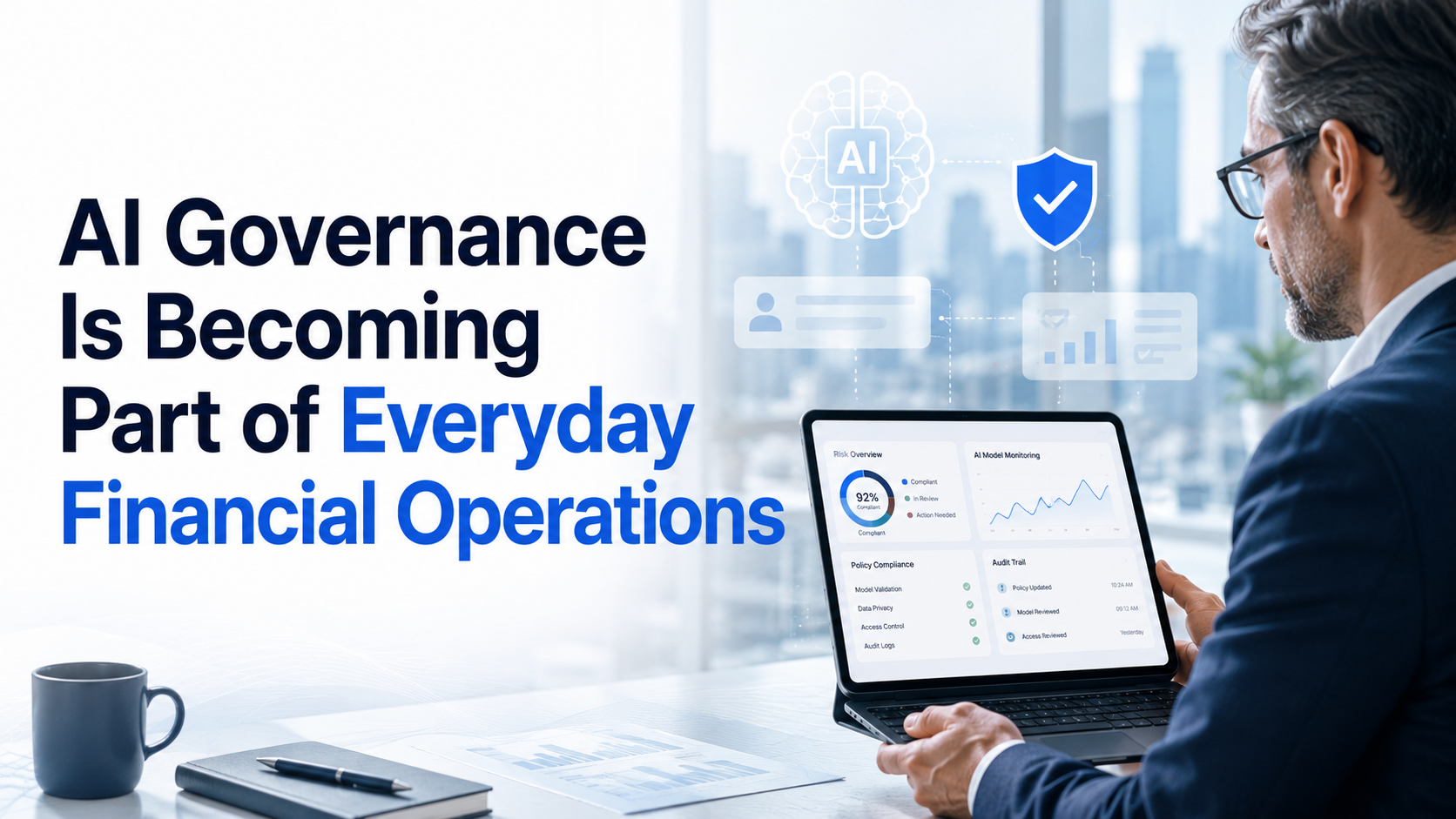
Artificial intelligence is moving deeper into financial work. Teams are using it to summarize reports, review documents, identify unusual transactions, prepare forecasts, support customer service, and speed up routine analysis. These applications can reduce administrative effort, but they also introduce questions that cannot be answered through technology alone.
Who owns the result produced by an AI system? Which records can it access? How should employees verify its recommendations? What happens when the system produces incomplete or incorrect information? Which actions can move automatically, and which require approval?
These are governance questions, but they are also daily operational questions.
Financial organizations can no longer treat AI governance as a policy document created only for compliance teams. Governance must become part of how AI-supported work is assigned, reviewed, approved, recorded, and monitored across the organization.
AI Risk Begins Before the Final Decision
Organizations often focus on the final output created by AI. A report may contain an incorrect figure, a recommendation may lack context, or a customer response may include information that should not have been shared.
However, risk begins earlier in the workflow.
The system may have accessed the wrong dataset. The employee may have submitted sensitive information to an unapproved tool. The AI may have used an outdated policy, incomplete transaction history, or financial record from the wrong reporting period.
A proper governance model must therefore examine the full process:
- What information entered the system
- Where the information came from
- Which AI model or service processed it
- What instructions were provided
- Who reviewed the result
- What action followed
- How the activity was recorded
Reviewing only the final answer does not explain how the system reached it or whether the workflow followed approved controls.
Personal AI Use Can Create an Unmanaged Operating Layer
Employees often begin using AI tools individually before the organization introduces a formal system. A finance employee may upload spreadsheet data to produce a summary. A manager may use a chatbot to rewrite an internal report. A customer service team may generate responses through a public AI platform.
These activities can save time, but they create an invisible operating layer outside normal business controls.
The organization may not know which tools employees are using, what information they are sharing, or how generated content affects financial decisions. Important analysis may exist only inside personal AI accounts, while there is no shared record of the sources, instructions, or review process.
Banning every AI tool is rarely a complete solution because employees still need practical ways to work more efficiently. A stronger approach provides approved AI capabilities inside controlled systems, with clear rules around data access and human review.
Permission Design Must Follow the Employee’s Role
AI should not receive broad access simply because it can process information quickly.
A payroll employee may require access to salary records but not supplier contracts. A procurement manager may need purchasing and vendor data but not confidential employee documents. A branch manager may review local performance without seeing unrestricted information across the entire organization.
The AI system should follow the same access principles.
When an employee asks an AI assistant for information, the assistant must respect the permissions connected to that employee’s role. It should not retrieve records the user could not access directly. It should also avoid combining separate datasets in ways that reveal restricted information indirectly.
Permissions should cover both data retrieval and action. An employee may be allowed to view a payment record but not approve it. The AI may prepare a payment summary, but it should not move the transaction forward without the required authorization.
Good governance applies business permissions to every stage of AI-supported work.
AI Recommendations Need Visible Evidence
Financial decisions require context. A recommendation to delay a payment, adjust a budget, investigate an expense, or change a forecast should not appear without explanation.
Employees need to understand which information the AI reviewed and why it reached a conclusion.
For example, an AI system may flag an invoice as unusual because the value exceeds previous transactions with the supplier. That could indicate an error, but it may also reflect a legitimate annual purchase or contract change.
A useful recommendation should include:
- The transaction or record being reviewed
- The data points that triggered the alert
- The relevant comparison or policy
- The level of confidence or uncertainty
- Missing information that could affect the result
- The person responsible for the final decision
This does not require the system to expose every technical detail of the model. It requires enough operational evidence for an employee to review the recommendation responsibly.
Human Review Must Be Assigned, Not Assumed
Many organizations say that humans remain involved in AI-supported decisions. However, the workflow may not identify which human is responsible, when they must review the result, or what evidence they should consider.
A vague statement about human oversight does not create accountability.
Each AI-supported process should define a reviewer based on the type and risk of the activity. Routine summaries may require only the employee who requested them. A transaction alert may require a finance manager. A high-value payment, credit decision, or policy exception may need several levels of approval.
The reviewer should receive a clear task rather than a general notification. The task should contain the recommendation, supporting records, decision options, and required response date.
The system must also record whether the reviewer accepted, modified, or rejected the AI recommendation.
Automation Levels Should Reflect Financial Risk
Not every AI-supported task requires the same level of control.
A system may automatically classify routine documents or send reminders for missing information. However, it should not use the same automatic process for sensitive decisions involving payments, credit, payroll, fraud, or customer eligibility.
Organizations can define several automation levels.
Advisory
The AI provides information or recommendations, but it does not change any business record.
Assisted
The AI prepares a draft, task, transaction, or workflow. An employee reviews it before submission.
Controlled Automation
The system completes a routine action when all approved rules are met. Exceptions are sent for review.
Restricted
The AI can analyze the case, but only authorized employees can complete the action.
This structure helps teams automate low-risk work while maintaining stronger control over activities with financial, legal, or customer impact.
Model Errors Need an Operational Response Process
AI systems can produce incorrect, incomplete, or unsupported results. Governance should define what employees must do when this occurs.
The response may involve correcting the immediate output, reporting the issue, identifying affected records, and reviewing whether the same problem appeared elsewhere.
Without a formal process, employees may simply rewrite the result and continue working. The business then loses the opportunity to identify a wider issue.
An AI incident record may include:
- The affected workflow
- The incorrect output
- The input and data source
- The employee who identified the issue
- The action already taken
- The potential financial or customer effect
- The required follow-up
- The final resolution
Patterns across these records can show where prompts, data quality, permissions, or model behavior require improvement.
Data Quality Becomes a Governance Responsibility
AI can process large amounts of information quickly, but it cannot make unreliable business data trustworthy.
Duplicate supplier records, outdated customer information, inconsistent account codes, incomplete documents, and delayed system updates all affect AI results. The output may sound confident even when the underlying records are incomplete.
Financial organizations need clear ownership for the data used by AI. Teams should know which system provides the official record, who can correct it, and how frequently it is updated.
Important controls may include:
- Required fields for financial records
- Duplicate detection
- Document validation
- Approved account and cost-center structures
- Clear effective dates for policies and rates
- Controlled changes to supplier and customer information
- Regular review of integrations and data feeds
AI governance is therefore connected to ERP governance. Better AI depends on stronger operational data.
Audit Trails Must Include AI Activity
Traditional audit trails record who created, changed, approved, or deleted a business record. AI adds another participant to the process.
Organizations need to know when AI retrieved information, generated a recommendation, prepared an action, or triggered a workflow. The system should also record the employee who initiated the request and the person who approved the final outcome.
A useful AI audit trail may show:
- The user and time of the request
- The workflow involved
- The records accessed
- The output or recommendation created
- The reviewer’s response
- Any changes made before approval
- The final action completed
This history supports internal review, compliance, and process improvement. It also prevents AI-supported work from becoming a black box outside the organization’s existing controls.
Governance Should Not Make AI Impossible to Use
Poor governance creates unnecessary barriers. Employees face long approval processes for simple tools, while unapproved personal use continues because the official system is too difficult.
Good governance should make responsible use easier than unmanaged use.
Employees need approved tools, practical guidance, clear examples, and simple reporting processes. Policies should explain which information can be used, which activities require review, and what employees should do when an output appears unreliable.
Training should focus on real tasks rather than abstract AI theory. Finance teams need examples connected to reporting, reconciliation, payment review, document processing, forecasting, and customer communication.
The objective is not to prevent AI use. It is to make AI use visible, controlled, and useful.
How Synclo Supports Governed AI Operations
Synclo connects Alci with finance, HR, procurement, supply chain, projects, documents, recruitment, support, and reporting workflows.
Because Alci operates within the connected business platform, its access can follow the user’s permissions and role. It can retrieve approved information, prepare summaries, identify exceptions, and support actions without bypassing existing workflows.
Sensitive actions can remain subject to defined approval rules. Managers can review the supporting information, modify the proposed action, and record the final decision. Requests, approvals, documents, and system changes remain connected to the same operational history.
This gives organizations a practical foundation for using AI without creating a separate uncontrolled layer beside the ERP.
Governed AI Becomes More Useful AI
Financial organizations do not need to choose between innovation and control. AI can support faster work while remaining subject to permissions, evidence, approvals, and audit requirements.
The strongest governance model is not a policy stored away from daily operations. It is a set of controls built into the way work moves.
Employees should know what AI can access, how its output must be reviewed, and who remains responsible for each decision. Managers should be able to see where AI is used and how recommendations affect business activity. Compliance teams should have records that explain the full process.
AI governance becomes valuable when it improves both trust and execution.
The future of financial AI will not depend only on which organization adopts the most tools. It will depend on which organization can use those tools consistently, responsibly, and within the controls that protect the business and its customers.
